As an experiment, I am paywalling all my posts in December. This has to do with becoming a father and needing to pay for more family related expenses.
We are finally ready to share our big follow-up to the first Admixture in the Americas project from 2016.
Fuerst, J., & Kirkegaard, E. O. W. (2025, December 5). Continental Genetic Ancestries as Predictors of Socioeconomic and Cognitive Variation Across the Americas. https://doi.org/10.31235/osf.io/vgfrb_v1
We draw upon newly compiled subnational indicators from fifteen countries to revisit relationships between continental genetic ancestry, cognitive ability (CA), and socioeconomic outcomes (S) in the Americas. Across national and subnational analyses, West Eurasian ancestry, in contrast to Amerindian and African, correlates robustly and positively with CA and S. In models including country fixed effects a shift from 0% to 100% West Eurasian genetic ancestry corresponds to an estimated increase of approximately 1.0–1.3 in either CA or S in units of standard deviation. Models that include both country fixed effects and random slopes produce similar estimates. These associations remain stable when controlled for geoclimatic variables (e.g., annual temperature, precipitation, UV-radiation). Although the cross-sectional nature of the data precludes formal causal inference, the results are consistent with CA mediating roughly 50% of the association between West Eurasian ancestry and S. The findings provide additional support for the “deep roots” hypothesis that continental ancestry is systematically linked to regional variations in cognitive and socioeconomic outcomes across the Americas.
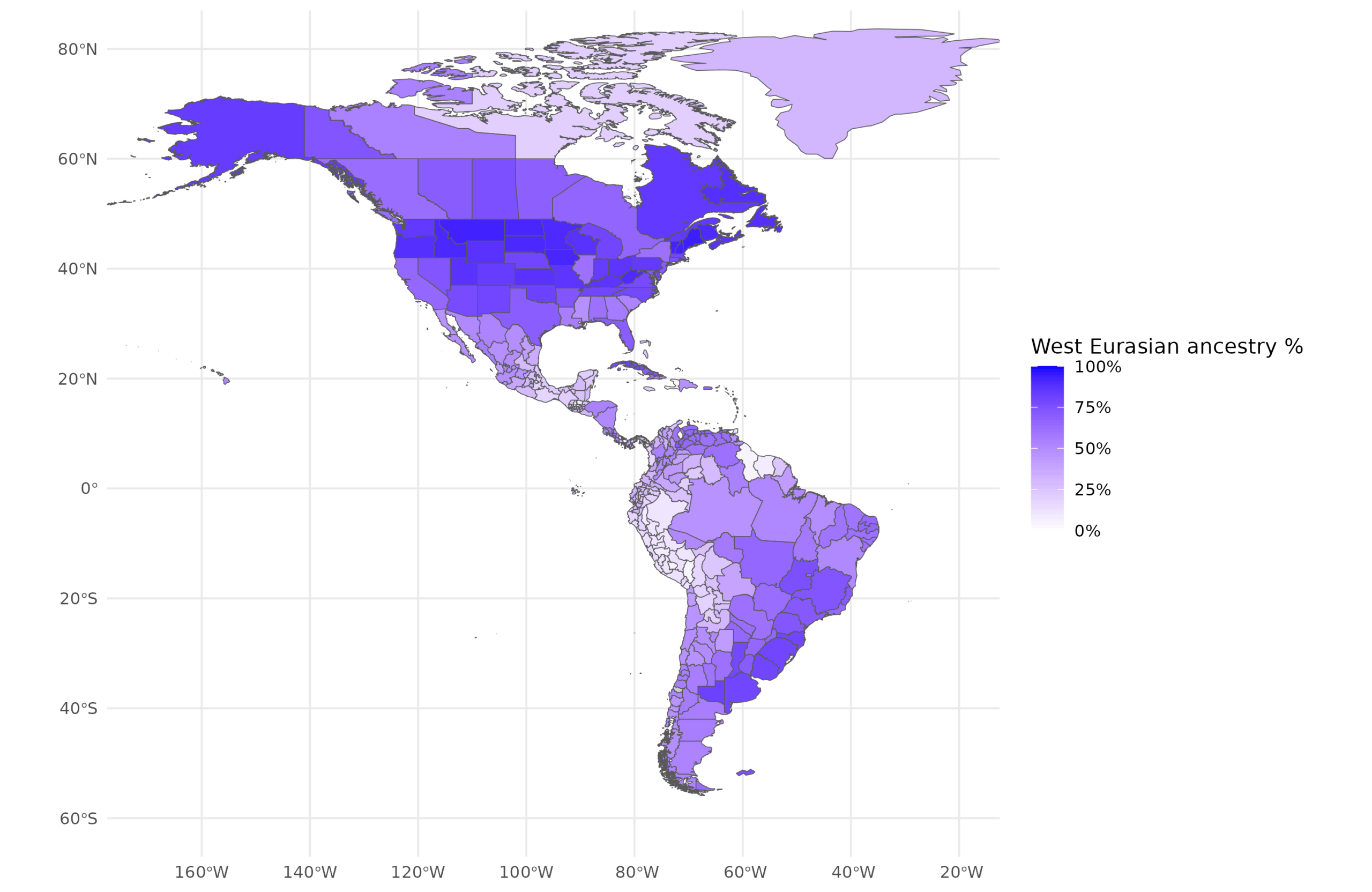
It has been repeatedly shown in prior research that (genetic) ancestry (race) predicts outcomes at the individual level (see our work using ABCD, PNC, and PING), and also Meng Hu’s new post on our new meta-analysis of correlations. Various economists have also used rough estimates of country (Easterly & Levine 2016) and subnational ancestry (e.g. US counties, Fulford et al 2020) to predict outcomes (usually just GDPpc). This is part of the so-called deep roots literature. So back in 2016 we gathered genetic studies from various countries and subnational units in the Americas. We showed that European, African, and Amerindian ancestry are predictive of the level of development in the countries, alone and net of plausible controls. In our new study we expand upon this project but with more data and stronger methods. The basics of ancestry variation in the Americas look like this. European: