

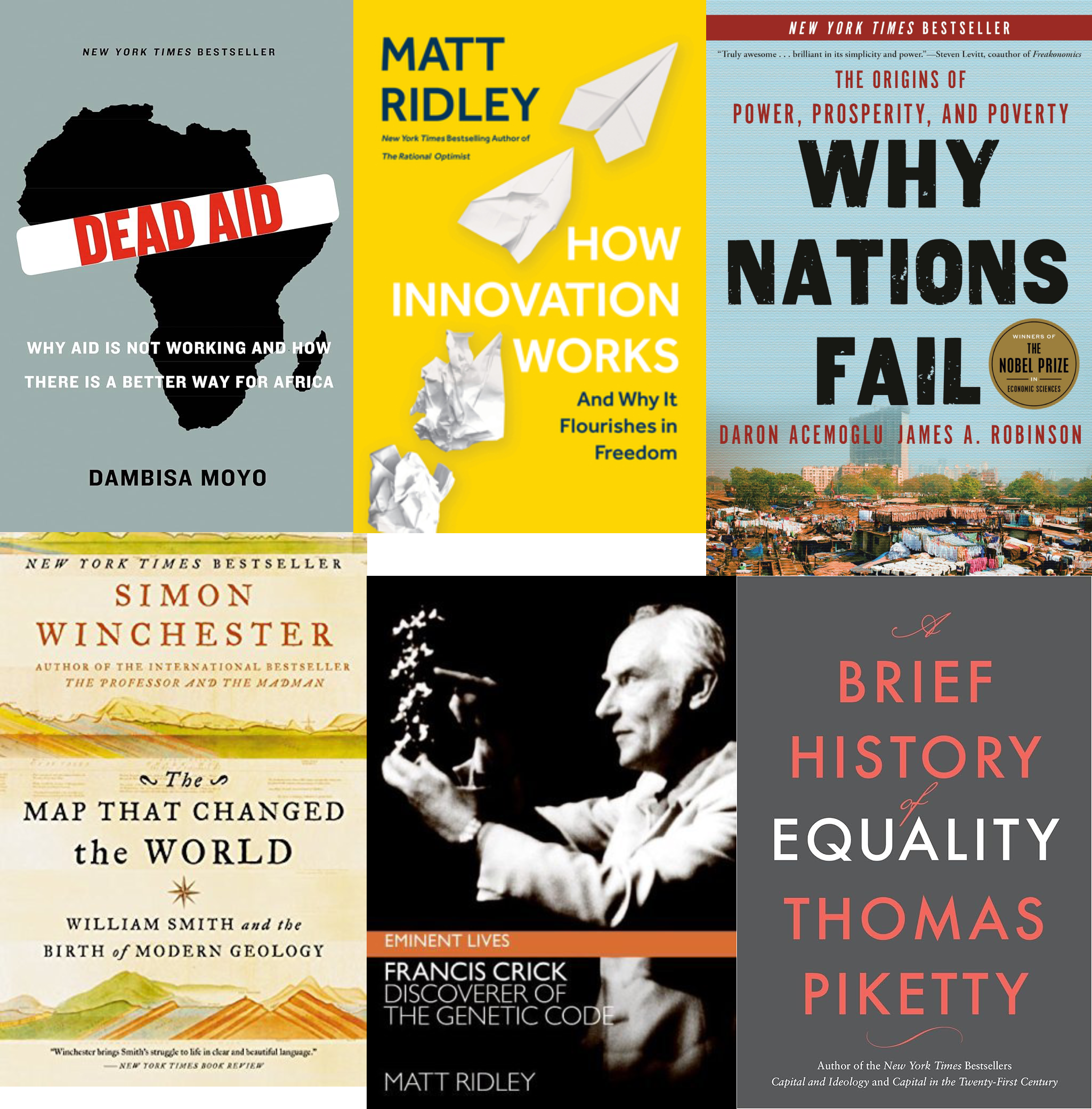
I tend to write 2 types of book reviews: 1) full length singular posts, and 2) short summaries for many books by year’s end. The trouble with the second approach is that it has been up to 12 months since I read some of the books involved. So I’ve decided on a new approach, which is to post once a month for books from the prior month. This also serves as a motivation to get some reading done. In January I read 6 books:
Why Nations Fail: The Origins of Power, Prosperity, and Poverty, by Daron Acemoğlu
A Brief History of Equality, by Thomas Piketty
How Innovation Works: Serendipity, Energy and the Saving of Time, by Matt Ridley
Francis Crick: Discoverer of the Genetic Code, by Matt Ridley
The Map That Changed the World: William Smith and the Birth of Modern Geology, by Simon Winchester
Dead Aid: Why Aid Is Not Working and How There Is a Better Way for Africa, by Dambisa Moyo
In an image:
Why these books? Well, no reason in particular. I decided to read some mainstream stuff I had been avoiding. I set my Goodreads to-read list to sort by most reviews, and these were chosen from among the top. 3 of the books concern big inequality questions. Take Thomas Piketty. He’s a die-hard socialist of sorts. Some years ago he wrote a supposedly important book Capital in the Twenty-First Century (2013). The problem with reading this is that it’s 700 pages long, and I was already expecting not to enjoy it too much. So I looked around for a more up to date book from him that was shorter. So let’s begin in that order too.
Piketty’s A Brief History of Equality
First, Piketty on ‘social constructions’
Let us restate the point clearly: socioeconomic indicators, like the historical series presented in this work and all statistics in general, are nothing more than imperfect, temporary, and fragile constructions. They do not claim to establish “the” truth of figures or the certainty of “facts.” There are always several legitimate ways of combining the materials available to confer a specific social, economic, and historical intelligibility on the given information. The indicators seek above all to develop a language enabling us to establish orders of magnitude, and especially to compare in the most sensible way possible situations, historical moments, epochs, and societies that often consider themselves to be very distant from one another, but which it may nonetheless be useful to correlate in spite of their irreducible specificity and uniqueness. We cannot be content to say that each statistic is a social construction: that is, of course, always true, but it is insufficient because it amounts to abandoning the field. Used properly, moderately, and critically, the language of socioeconomic indicators is an indispensable complement to the natural language for fighting intellectual nationalism, escaping the manipulations of economic elites, and building a new egalitarian horizon.
I am not sure why some people find the talk of social construction so important. It’s obvious that all concepts we use (think in terms of) are those made by us humans, and usually by building on existing concepts, thus they are in a sense social. One could have made some different concepts, and new concepts are constantly invented. This is not really related to whether they are useful or not, or whether they map well to nature or not. I take it as trivial that the correspondence theory of truth is correct. Anyway, Piketty’s book is full of assumed statements along the highlighted one. Nowhere does he discuss why it is we should care about equality in itself, but it’s good that he doesn’t go for postmodernism about social construction. He is working with actual data, and some of it is quite interesting, so accepting some kind of social constructionism would undermine his own intellectual project. You can’t prove socialism is good/capitalism is bad using statistics if statistics are just made up. To give you a flair of his standard opinions:
How did Europe and the United States attain such a dominant position on the global level, at least until recently? Although no single explanation exists, we shall see that slavery and colonialism played a central role in the Western world’s acquisition of wealth. Today, the distribution of wealth among countries, as well as within them, is still deeply marked by this heritage. Therefore, it is particularly important to examine these historical episodes closely.