

Most countries have severe limitations on free speech. Historically, freer speech was a characteristic of western countries, but not so much anymore, with the exception of the United States. And even there there free speech is severely limited by non-state actors getting you fired, your bank accounts canceled and so on, but at least the state itself does not persecute you.
Since I am Danish, I am familiar with our own atrocious law commonly called the racism paragraph (racismeparagraffen, 266b). The historical origin of the law is that Nazi propaganda about the Jews were spilling over from our aggressive southern neighbor and the Danish parliament tried to protect the local Jews (0.1% of population). As far as I can tell, the law was then mostly dormant until the benefits of mass migration from the 3rd world were felt. The prosecutor’s office provides case summaries of every case since the year 2000, so we can see who is being protected by the state in Denmark. In total, there were 142 guilty verdicts in the lower courts (byretten) from then till now. Some of these were appealed to the higher courts, but to avoid double counting, I am just using the lower court judgements here. The timeline looks like this:
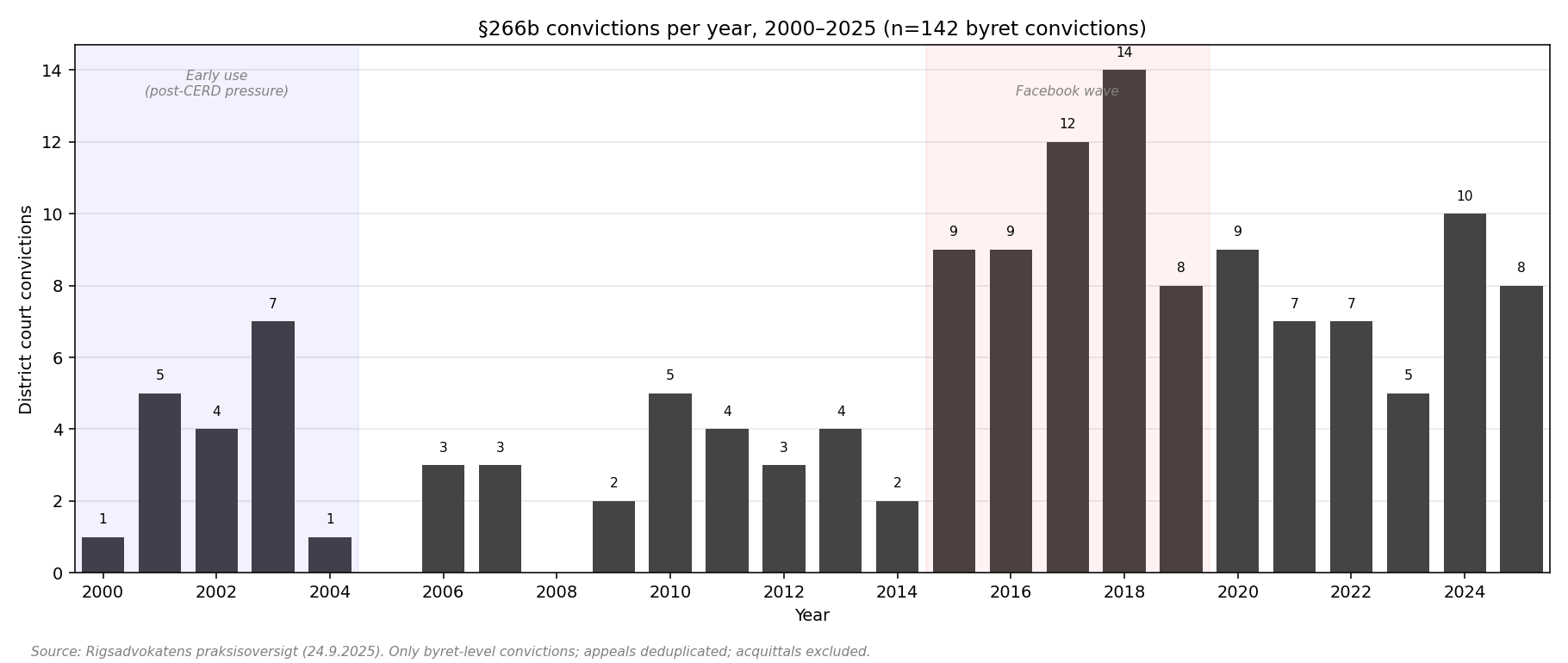
The state is thus increasingly hostile to speech that involves insulting various groups. Some of the increases in persecution also comes from various super-national bodies that change legal practice by adding more protected groups.
But is the law fair? Which groups are being protected from hostile speech? I initially did my own classifications of each case and tabulated them. However, since the cases keep accumulating I’ve had Claude do it again now. It looks like this:
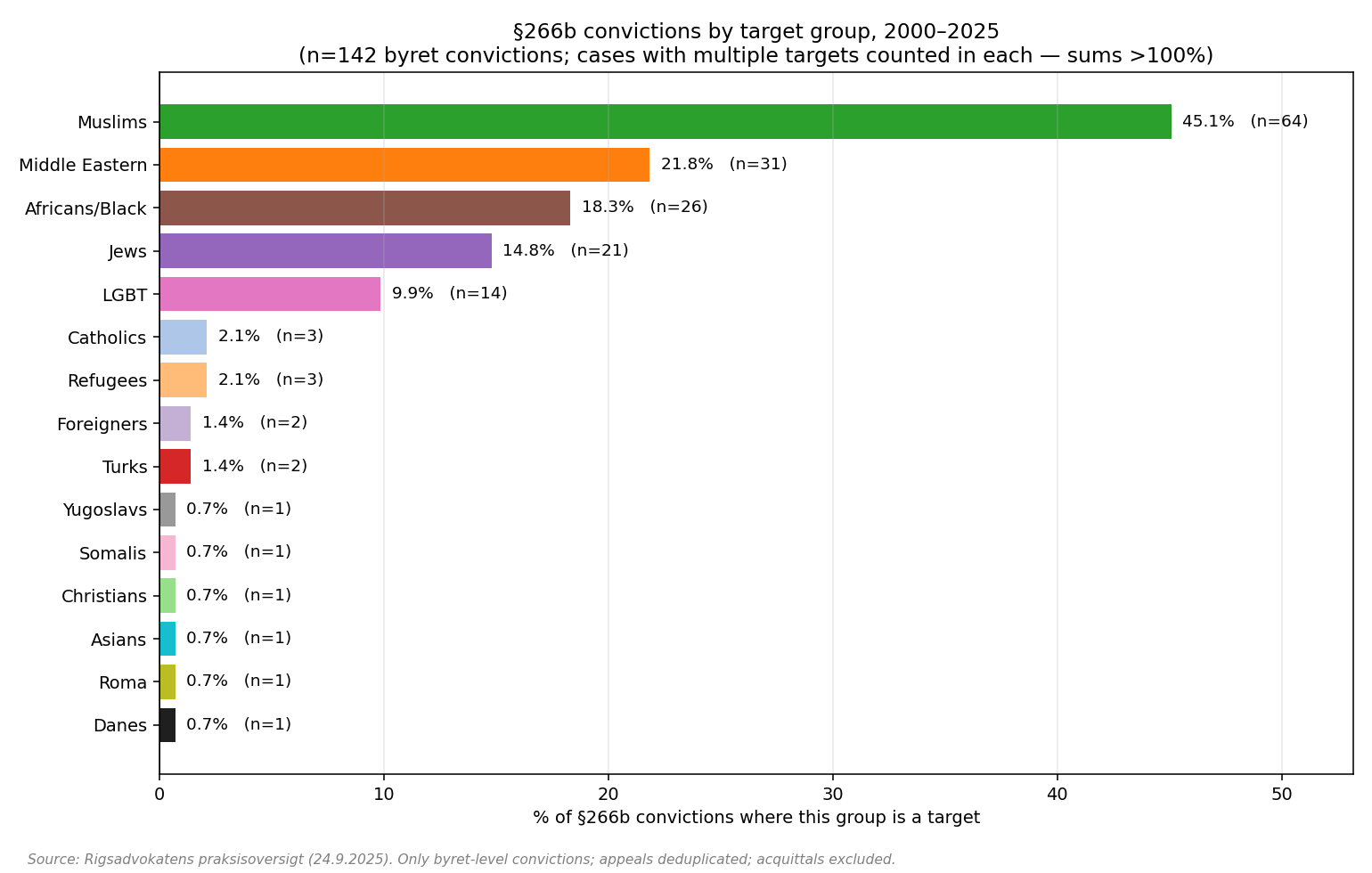
My own tabulations were materially the same. Thus, the large majority of cases concern statements or utterances about non-Danes. In fact, most of the verdicts about potentially Danish people were forced by opponents of the law that published parallel versions of statements to test the legal boundaries. Thus, because an Iranian immigrant had written something about Muslims (she’s anti-Islam) and was found guilty, in protest they decided to write her statements again but with the target group changed to various other groups such as the Catholics (a tiny minority of Danes), Eskimos and so on. Most of these did not lead to guilty verdicts, but a few of them did. The one case that involving protecting the native population was even incidental since it was a spillover of a deranged rant against Jews/Israel on a public bus that also involving threatening others (case 1.1.119):
[machine translation]
Judgment 1.1.119. – Judgment of the Court of Appeal of 14 March 2024
60 days in prisonViolation of section 266 of the Penal Code, cf. section 81 (6) and section 266b (2). 1, by May 11, 2023 during the period from approx. 17.00 to approx. at. 19.55 in a bus to have threatened to commit a criminal offense and publicly or intentionally to spread in a further opinion or national or ethnic origin or belief or his disability or because of the sexual orientation of the group concerned, gender identity, gender expression or gender characteristics were threatened, mocked or degraded, with the intention of the bus’s passengers to hear the opinions, i.a. stated: ”When I come to Aarhus, I skip the shit in the air ” [Name] 1> [Names] 1”I fucking throw you out of the bus and fucking stab you ”, ”Fucking Danes! You are all Jews and you must be blown up in the air – both women and children and family ”, ”Danish pigs, you should be killed ” Danish pigs, you should be shot ”, ” Danish pigs, you should bomb ”should I have the Jews ” everything suitable to cause serious fears about the lives, health or welfare of passengers.everything suitable to cause serious fears about the lives, health or welfare of passengers.
Clearly, this person should be punished but not in my opinion for insulting the Danes or Jews, but because such threatening behavior should not be tolerated on a bus.
The law is clearly not being used fairly, but benefits foreigners at the expense of Danes who are at legal risk for even making fairly accurate predictions of the outcomes of migration. Particularly bad was the case of a political advertisement from the Danish People’s Party:
[machine translation]
Judgment 1.1.9. - Judgment of the Court of Justice of 11 October 2002
5 day fines of DKK 500 for both defendantsViolation of section 27 (2) of the Media Liability Act 2, cf. section 266b (b) of the Penal Code. 1, and Media Liability Act section 27 (2). 1, by publishing an ad in a trade magazine printed in 40,000 copies and free of charge to higher education institutions. The ad had the following text: ”Mass rapes, harsh violence, insecurity, forced marriages, women’s repression, gang crime. That’s what a multi-ethnic community offers us ”. The text was accompanied by a picture of three young light-haired girls with the subtitle ”Denmark today ” as well as a picture of three hooded, blood-plated men who show the Qur’an, with the subtitle ”Denmark in 10 years ”. The district court found that the fact that the defendants, due to hustleness up to the magazine’s deadline, did not see the ad until it was printed, cannot lead to impunity due to lack of intent. However, the district court did not find either,that such a systematic, intensive or sustained dissemination of discriminatory communications in order to influence the formation of opinion that there had beencget propaganda business, cf. 2nd See also Østre Landsret’s judgment of 9 May 2003, section 2.2., (judgment 2.2.4.) concerning the same ad.
Anyone can look up the crime statistics and confirm that those predictions were accurate.
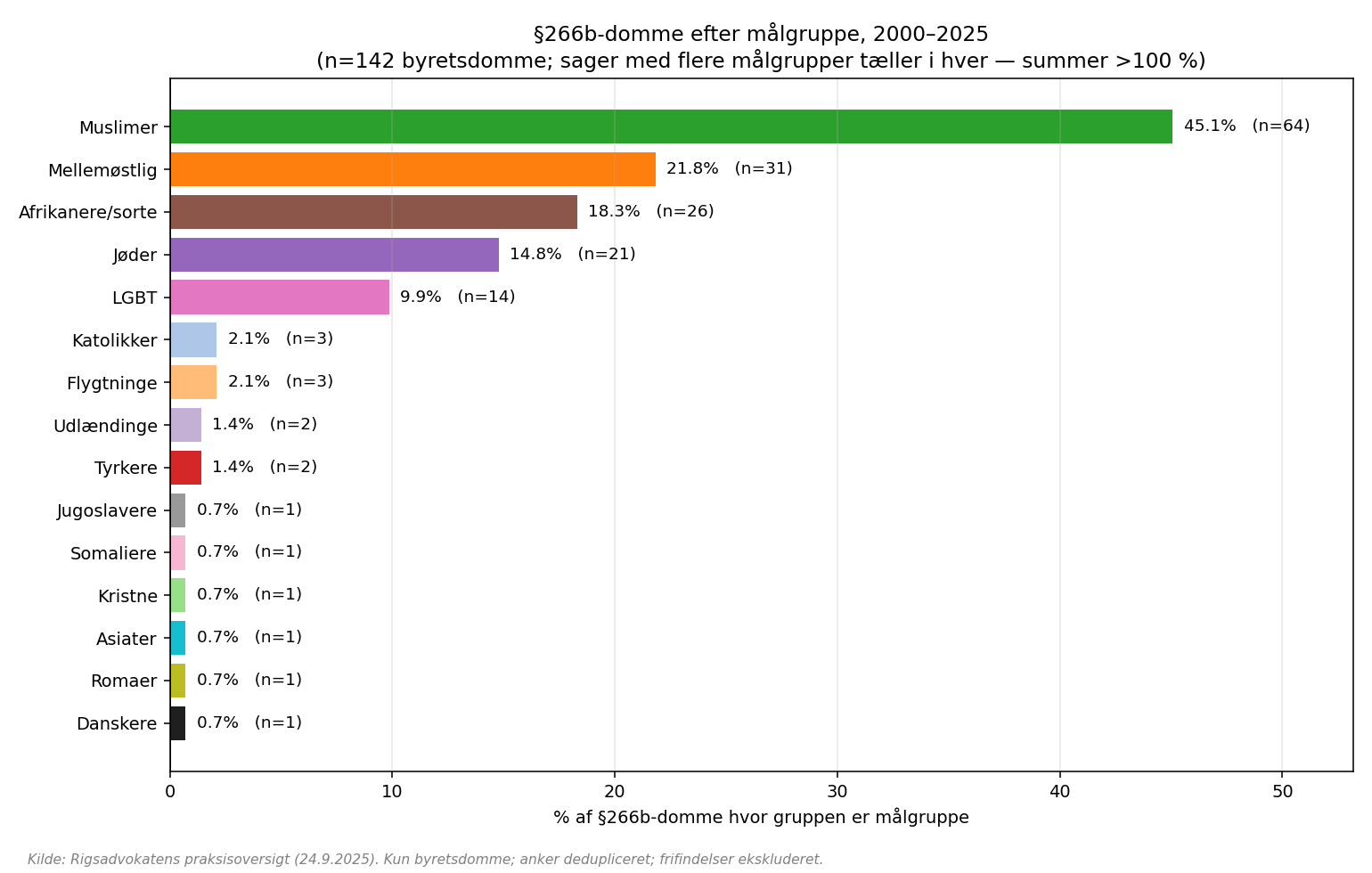
Danish version of the plots, by target group:
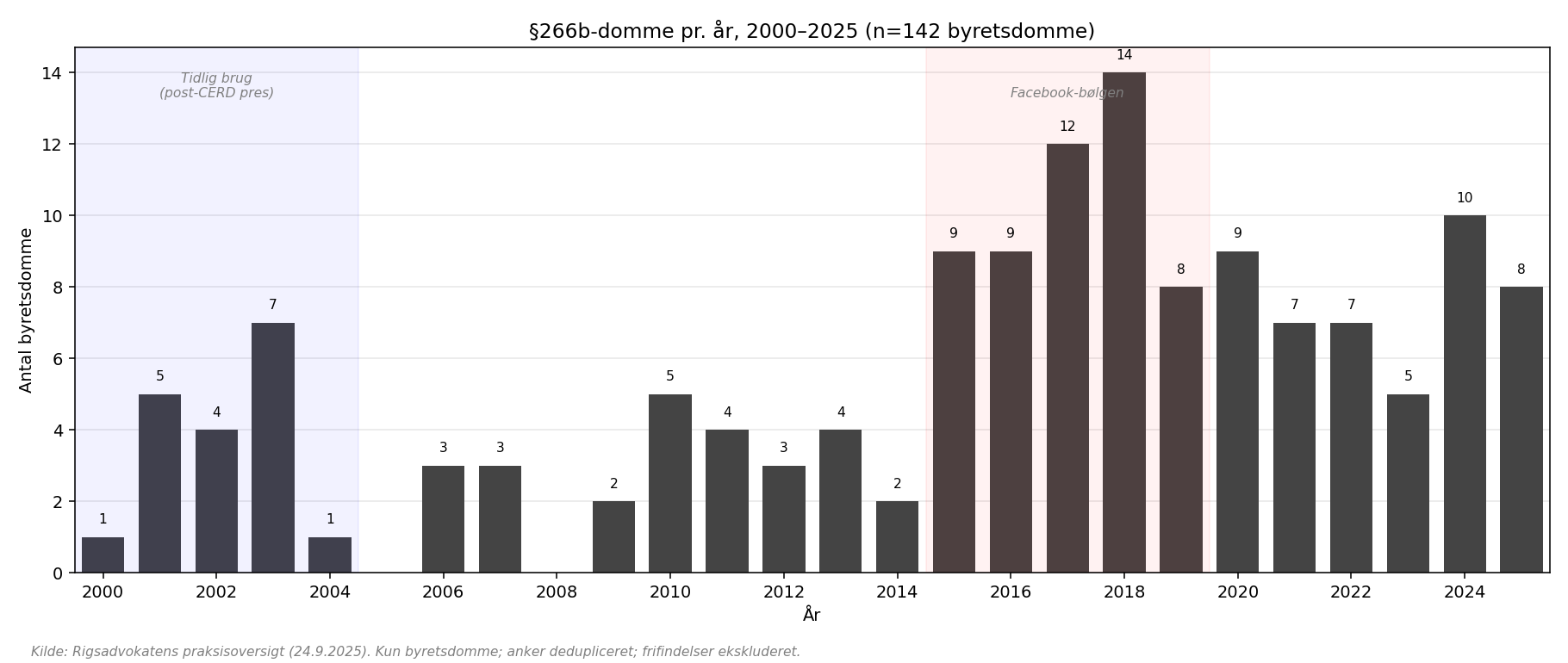
Antal domme:
_very_ unsurprising, but it is a public service to write this up
EU is killing itself and all we can do is watch it happen as the majority still support it. Very disappointing people. I'm embarrassed to be a swede.