

I decided to review all books I read, which also serves as a motivator for making notes when reading (actually, I only highlight text and memory is usually enough reconstruct why it was marked). Having covered the two long, political books, let’s cover Matt Ridley’s How Innovation Works: Serendipity, Energy and the Saving of Time (2020).
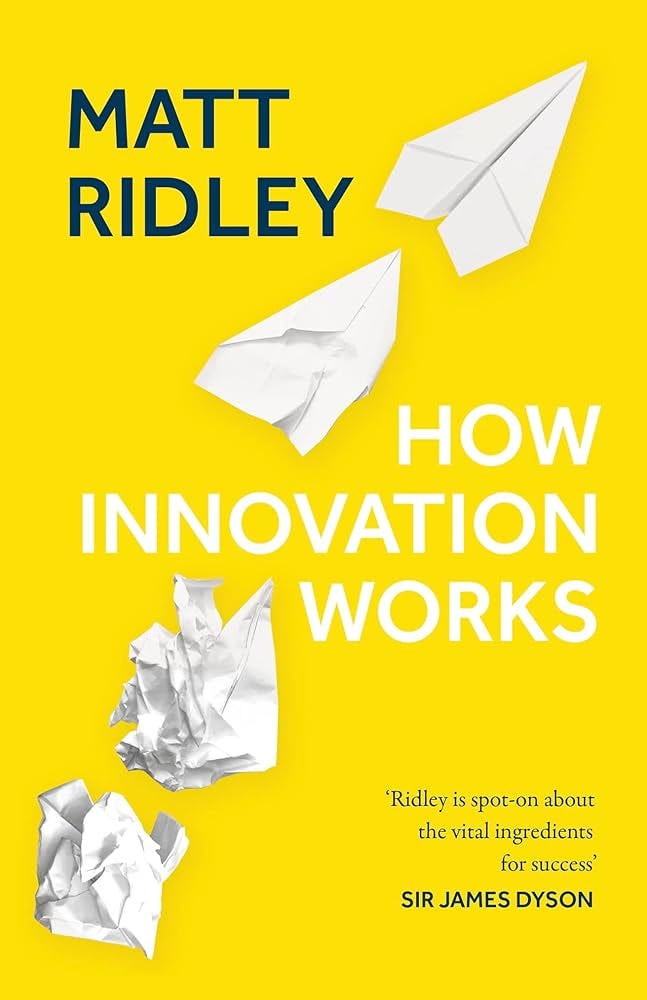
It’s a history of technology book, with some comments on the related political and legal climate. In particular, Ridley is very critical of intellectual ‘property’, that is, various property limitations due to monopolies granted by the government (cf. Against Intellectual Monopoly). Granted, the aim of them is to increase innovation but frequently they do exactly the opposite. The commonly cited example is the development of steam engines which was continuously slowed down by a variety of patents:
In 1763 a skilled and practical Scottish instrument maker, by the name of James Watt, was asked to mend a model Newcomen engine belonging to the University of Glasgow. The thing barely worked. In trying to understand what was wrong, Watt realized something about Newcomen engines in general that should have been spotted much earlier: three-quarters of the energy of the steam was being wasted in reheating the cylinder during each cycle, after it had been cooled with injected water to condense the steam. Watt had the simple idea of using a separate condenser, so that the cylinder could be kept hot, while the steam was drawn off for condensing in a cooler container. At a stroke he had improved the efficiency of the steam engine, though as usual it took months of work to get the metalworking right to make his ideas into practical devices.
After demonstrating the principle in a small test engine, Watt went into partnership with first John Roebuck to acquire a patent, then the entrepreneur Matthew Boulton to build full-scale versions. They unveiled the machine on 8 March 1776, a day before the publication of The Wealth of Nations, written by another Scot, Adam Smith. Boulton wanted Watt to develop a method of converting the up-and-down motion of the piston into a circular motion capable of turning a shaft for use in mills and factories. The crank and flywheel had been patented by James Pickard, which stymied Watt for a while and forced him to develop an alternative system, known as the sun-and-planets gear. Pickard in turn had got the idea of the crank from a disloyal and drunken employee of Boulton’s own Soho factory, leaving the origin of this simple device mired in confusion.
Despite this example of patents getting in the way of improvement, as Savery’s had for Newcomen, Watt himself was an enthusiastic defender of his own patents, and Boulton was adept at using his political contacts to acquire long-lasting and broad patents on Watt’s various inventions. Just how much Watt’s litigiousness delayed the expansion of steam as a source of power in factories is a hotly contested issue, but the ending of the main patent in 1800 certainly coincided with a rapid expansion of experiments and applications of steam. Indeed, one source of steady and incremental improvement in the efficiency and penetration of steam engines came as a result of the publication of a journal, Lean’s Engine Reporter, founded by a Cornish mining engineer named John Lean, which acted like an open-software movement, disseminating suggestions for improvement among many different engineers. My point is simple: Watt, brilliant inventor though he undoubtedly was, gets too much credit, and the collaborative efforts of many different people too little.
Five years after Watt died in 1819, there was a subscription to build a monument to him, unusual in those days when monuments were mostly to those who won wars. The editors of a journal called The Chemist had this to say, rather perceptively: ‘He is distinguished from other public benefactors, by never having made, or pretended to make it his object to benefit the public . . . This unpretending man in reality conferred more benefit on the world than all those who for centuries have made it their especial business to look after the public welfare.’
Also for airplanes: