

In this 4th book review of those I read in January, we come to Dead Aid: Why Aid Is Not Working and How There Is a Better Way for Africa, by Dambisa Moyo:
There are many books on the general relative dysfunctionality of Africa. Most of them tell some variant of ‘your ancestors did it’ (European colonialism to blame). Of those that don’t there’s the Acemoglu (whose book I reviewed the other day) non-explanation of corruption/extractive institutions which just leaves us with the question of why they keep implementing such institutions around the world -- Africans in the Caribbean and local authorities in USA also have corrupt governments. Of those who aim for deeper (root) causes, we have e.g Jared Diamond’s geographical/natural biome model. In this model, African poverty has nothing to do with the people, it has to do with bad climate and the wrong animals. His model has the same issue with explaining why Africans outside Africa are also low functioning.
Now this book is not another Big Picture theory, it is mainly concerned with explaining why Africa doesn’t improve when (mostly) Westerners have kept trying to improve it with billions of developmental aid and volunteering. The author is a Black woman, and her explanation is that developmental aid messes with the free market and encourages corruption:
Deep in every liberal sensibility is a profound sense that in a world of moral uncertainty one idea is sacred, one belief cannot be compromised: the rich should help the poor, and the form of this help should be aid.
The pop culture of aid has bolstered these misconceptions. Aid has become part of the entertainment industry. Media figures, film stars, rock legends eagerly embrace aid, proselytize the need for it, upbraid us for not giving enough, scold governments for not doing enough – and governments respond in kind, fearful of losing popularity and desperate to win favour. Bono attends world summits on aid. Bob Geldof is, to use Tony Blair’s own words, ‘one of the people that I admire most’. Aid has become a cultural commodity.
Millions march for it.
Governments are judged by it.
But has more than US$1 trillion in development assistance over the last several decades made African people better off? No. In fact, across the globe the recipients of this aid are worse off; much worse off. Aid has helped make the poor poorer, and growth slower. Yet aid remains a centrepiece of today’s development policy and one of the biggest ideas of our time.
The notion that aid can alleviate systemic poverty, and has done so, is a myth. Millions in Africa are poorer today because of aid; misery and poverty have not ended but have increased. Aid has been, and continues to be, an unmitigated political, economic, and humanitarian disaster for most parts of the developing world.
That is, her thesis is that developmental aid is actually bad because it causes market failure and dependency:
There’s a mosquito net maker in Africa. He manufactures around 500 nets a week. He employs ten people, who (as with many African countries) each have to support upwards of fifteen relatives. However hard they work, they can’t make enough nets to combat the malaria-carrying mosquito.
Enter vociferous Hollywood movie star who rallies the masses, and goads Western governments to collect and send 100,000 mosquito nets to the a icted region, at a cost of a million dollars. The nets arrive, the nets are distributed, and a ‘good’ deed is done.
With the market flooded with foreign nets, however, our mosquito net maker is promptly put out of business. His ten workers can no longer support their 150 dependants (who are now forced to depend on handouts), and one mustn’t forget that in a maximum of five years the majority of the imported nets will be torn, damaged and of no further use.
This is the micro–macro paradox. A short-term efficacious intervention may have few discernible, sustainable long-term benefits. Worse still, it can unintentionally undermine whatever fragile chance for sustainable development may already be in play.
Certainly when viewed in close-up, aid appears to have worked. But viewed in its entirety it is obvious that the overall situation has not improved, and is indeed worse in the long run.
In nearly all cases, short-term aid evaluations give the erroneous impression of aid’s success. But short-term evaluations are scarcely relevant when trying to tackle Africa’s long-term problems. Aid effectiveness should be measured against its contribution to long-term sustainable growth, and whether it moves the greatest number of people out of poverty in a sustainable way. When seen through this lens, aid is found to be wanting.
That said, the approach to food aid (launched at the 2005 Food Aid conference in Kansas City7) has tried to push aid in a new direction, one which can potentially help African farmers. The proposal would allow a quarter of the food aid of the United States Food For Peace budget to be used to buy food in poor countries, rather than buying only American-grown food that has to then be shipped across oceans. Instead of flooding foreign markets with American food, which puts local farmers out of business, the strategy would be to use aid money to buy food from farmers within the country, and then distribute that food to the local citizens in need. In terms of the mosquito net example, instead of giving malaria nets, donors could buy from local producers of malaria nets then sell the nets on or donate them locally. There needs to be much more of this type of thinking.
The net story is fictive as far as I can tell, but generally something like this must be the case. If you give Africans free food, the demand for food is reduced and so local farmers’ revenues are harmed.
It should be said that she is not unaware of the more general theories, though she rejects them:
Historical factors, such as colonialism, have also often been put forward as explanations for Africa’s underachievement; the idea being that colonial powers delineated nations, established political structures and fashioned bureaucracies that were fundamentally incompatible with the way of life of indigenous populations. Forcing traditionally rival and warring ethnic groups to live together under the same flag would never make nation-building easy. The ill-conceived partitioning of Africa at the 1885 Berlin Conference did not help matters. The gathering of fourteen nations (including the United States, and with Germany, Britain, France and Portugal the most important participants) produced a map of Africa littered with small nations whose arbitrarily drawn borders would always make it difficult for them to stand on their own two feet – economically and politically.1
There is, of course, the largely unspoken and insidious view that the problem with Africa is Africans – that culturally, mentally and physically Africans are innately different. That, somehow, deeply embedded in their psyche is an inability to embrace development and improve their own lot in life without foreign guidance and help.
It is not the first time in history that cultural norms, social mores or religious beliefs have been cited as the reasons for differences in development between different peoples. The German political economist and sociologist Max Weber argued that a Protestant work ethic contributed to the speed of technological advancement and explained the development seen in industrial Britain and other European nations.
One might say in historical terms that developmental aid is just the latest round of western colonialism in Africa:
Africa was ripe for aid. The continent was characterized by a largely uneducated population, low-salaried employment, a virtually non-existent tax base, poor access to global markets and derelict infrastructure. Armed with the ideas and experience of the Marshall Plan, richer countries saw Africa as a prime target for aid. So aid began to appear.
As the US funnelled large sums to Europe through the Marshall plan, World Bank and IMF resources were freed up. Monies that had been earmarked by the Bretton Woods institutions for postwar European reconstruction could now be directed towards the emerging (African) development agenda.
Perhaps more crucially for the aid-based agenda that ensued, it was widely assumed that poor countries lacked the financial capital to spur development. In the wake of the Marshall Plan success, it became a widely accepted view that investment capital was critical for economic growth. In the absence of any significant domestic savings and lacking the physical and human capital to attract private investment, foreign aid was seen as the only way to trigger higher investment, which would thus lead to higher economic growth. As far as policymakers could see, there was no obvious alternative.
There were of course other reasons why Britain, America and to a lesser extent France turned their attention to Africa. By the mid-1950s Africa was undergoing profound changes – with Western powers loosening the chains of colonialism, many countries were gaining their independence. Countries such as Ghana in 1957, Kenya in 1963, and Malawi and Zambia in 1964 broke from the colonial fold to become independent states between 1956 and 1966; in all, thirty-one African countries did so. Independent they may have been on paper, but independence dependent on the financial largesse of their former colonial masters was the reality. For the West, aid became a means by which Britain and France combined their new-found altruism with a hefty dollop of self-interest – maintaining strategic geopolitical holds. For the US, aid became the tool of another political contest – the Cold War.
While the Cold War was peppered with outbreaks of physical hostility (for example, in Korea), much of the battle for world hegemony between the US and the USSR was fought economically and on foreign soil. The choice of weapon – aid. Africa saw many such battles. Aid became the key tool in the contest to turn the world capitalist or communist. The Soviet Union was, of course, a staunch supporter (and financier) of some of Africa’s greatest communists – Patrice Lumumba in Congo and Mengistu Haile Mariam in Ethiopia. And the US, by contrast, rewarded its supporters, such as Zaire’s Mobutu Sese Seko.
So the west moved into Africa in the 1800s to educate and Christian the locals, and this worked somewhat. After WW2, this got unpopular, so they moved out (often by force). The opposition movements (anti-colonialism/African nationalism) were sponsored by the Soviets (since they sponsor anti-western movements generally). Thus, lots of African countries ended up with nominally communist/socialist regimes. These in turn implemented very bad anti-market policies, thus causing more than the usual amount of market failure. After the fall of the USSR, funding stopped flowing to these communist regimes, and they turned to the next people who would give them free stuff, which were various pro-market quasi-western global organizations like the IMF. Thus, when aid is given, there are often strings attached:
The notion of a quid pro quo around aid was not new. Marshall Plan recipients had been required to adhere to a strict set of conditions imposed upon them by the US. They had a choice . . . you take it or you leave it. African countries faced the same choice.
Donors have tended to tie aid in three ways. First, it is often tied to procurement. Countries that take aid have to spend it on specific goods and services which originated from the donor countries, or a group selected by them. This extends to staff as well: donors employ their own citizens even when suitable candidates for the job exist in the poor country. Second, the donor can reserve the right to preselect the sector and/or project that their aid would support. Third, aid flows only as long as the recipient country agrees to a set of economic and political policies.
With stabilization and structural adjustment in vogue, the adoption of market-based policies became the requirement upon which aid would be granted. Aid would be contingent on African countries’ willingness to change from statist, centrally planned economies towards market-driven policies – reducing the civil service, privatizing nationalized industries and removing trade barriers. Later democracy and governance would make their way onto the list, in the hope of limiting corruption in all its forms.
On paper, conditionalities made sense. Donors placed restrictions on the use of aid, and the recipients would adhere. In practice, however, conditionalities failed miserably. Paramount was their failure to constrain corruption and bad government.
A World Bank study found that as much as 85 per cent of aid flows were used for purposes other than that for which they were initially intended, very often diverted to unproductive, if not grotesque ventures. Even as far back as the 1940s, international donors were well aware of this diversion risk. In 1947, Paul Rosenstein-Rodin, the Deputy Director of the World Bank Economics Department, remarked that ‘when the World Bank thinks it is financing an electric power station, it is really financing a brothel’.
But the point here is that conditionalities were blatantly ignored, yet aid continued to flow (and a great deal of it), even when they were openly violated. In other research, Svensson found ‘no link between a country’s reform effort or fulfilment of conditionality and the disbursement rate of aid funds’, proving once again that though a central part of many aid agreements, conditionalities did not seem to matter much in practice.
The string might be that the money has to be spent on products from the donor’s country. This makes developmental aid an inefficient subsidy of their own industries (these procurement conditions are now mostly phased out by international agreement). More recently, the aid is tied to forcing them to get rid of the communist legacy policies to encourage growth. This should work in theory but maybe not in practice.
Specifically on the Marshall plan as inspiration:
On 5 June 1947, at Harvard University, the US Secretary of State, George C. Marshall, outlined a radical proposal by which America would provide a rescue package of up to US$20 billion (over US$100 billion in today’s terms) for a ravaged Europe.2 As Europe emerged from the devastation of the Second World War with little to sell for hard currency, and experiencing one of the worst winters on record, General Marshall argued for an aggressive financial intervention by the United States. In return, European governments would draw up an economic revival plan.
Under the Marshall Plan, the United States embarked on an aid programme to fourteen European countries which saw the transfer of assistance worth roughly US$13 billion throughout the five-year life of the plan from 1948 to 1952. Among the top five aid recipients from the Marshall Plan were Great Britain, which received the lion’s share of 24 per cent, and France, Italy and Germany, which received 20, 11 and 10 per cent, respectively. In per capita terms smaller European countries received more support: Norway received US$136 per person, Austria US$131, Greece US$128 and the Netherlands US$111.
The idea that the Marshall Plan is hailed as a success has remained, to a large extent, unquestioned. The plan was clearly successful in bringing Western Europe back onto a strong economic footing, providing the US with the vehicle to influence foreign policy, winning it allies in Western Europe and building a solid foundation for US-led multilateralism. Aid had restored broken infrastructure. Aid had brought political stability, restored hope and not only given a future to defeated peoples, to bankrupt nations and to broken lands, but also benefited the donor nation itself, keeping the US economy afloat while the world around it had crumbled.
More importantly, if aid worked in Europe, if it gave to Europe what Europe needed, why couldn’t it do the same everywhere else? By the end of the 1950s, once reconstruction in Europe was seen to be working, attention turned towards other parts of the world, and specifically, in the context of aid, Africa.
It is curious that Germany received so little of this money despite being the most destroyed. I mean, it is fair enough since they began the war, but it doesn’t make sense from a utilitarian perspective. It didn’t ultimately matter though because the catch-up effect applies, so Japan and Germany (and wider Europe) relatively quickly regained their previous economic positions:
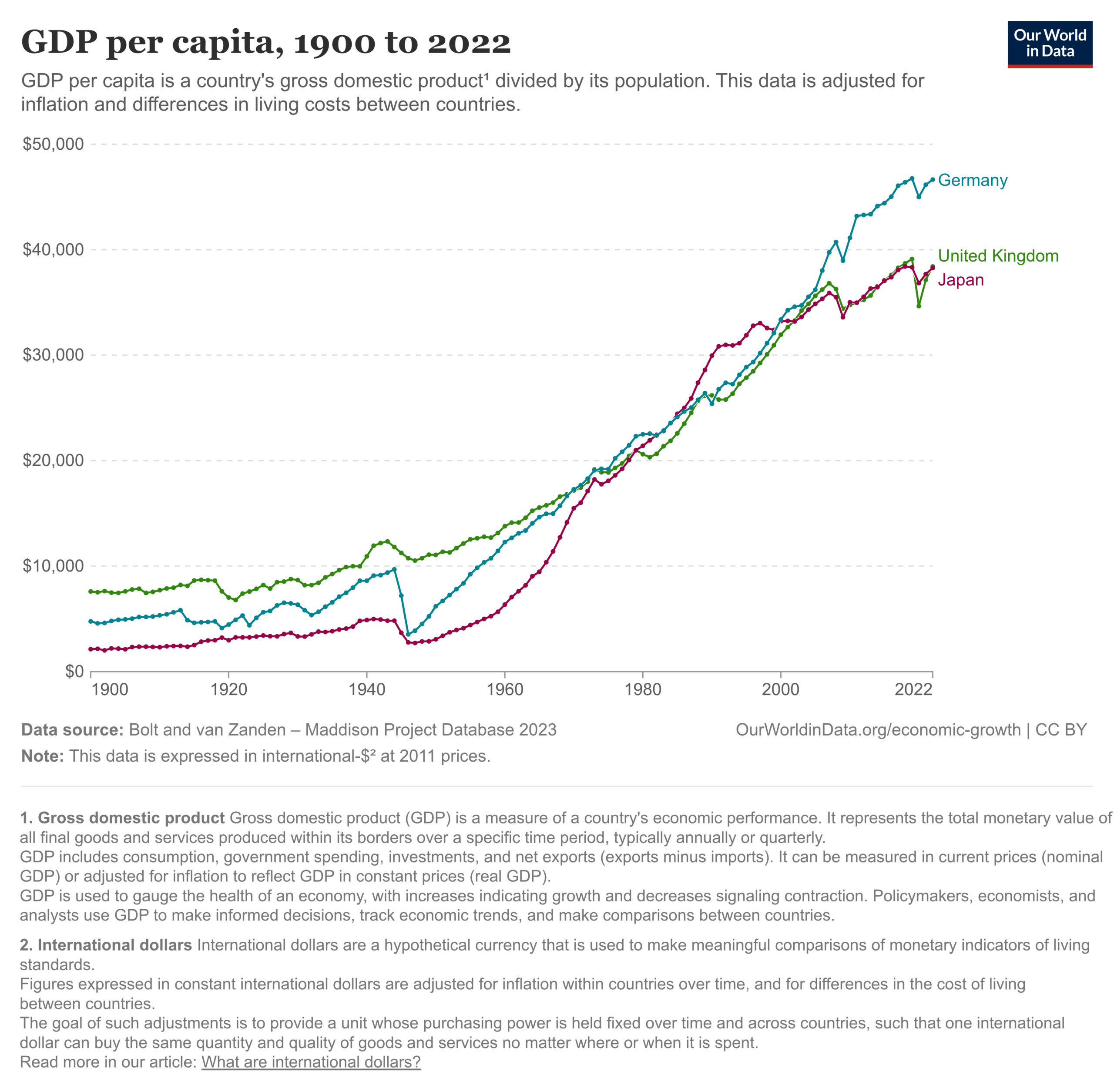
If you look closely, you can see UK and Germany dipped in the WW1 years (1914-1918), and Germany more so during the WW2 years and it’s aftermath (wartime GDP numbers are dubious). Nevertheless, if we look we can see that it took Germany only 11 years to reach back to their 1945 value (in 1956), and a few years later they have caught up to where they would have been. In fact, they overtook the UK, though perhaps because this is West Germany only (East Germany is poorer). These data do not fit with the Marshall plan working, as Germany received less aid but had more growth than the UK. If anything, this might suggest getting your country bombed to ruins is a Good Thing for economic growth. I mean, it is if one only looks at the effects afterwards since growth rates will accelerate until one returns to the long-term stable trajectory for that country.
On African life expectancy improvements:
Life expectancy has stagnated – Africa is the only continent where life expectancy is less than sixty years; today it hovers around fifty years, and in some countries it has fallen back to what it was in the 1950s (life expectancy in Swaziland is a paltry thirty years). The decrease in life expectancy is mainly attributed to the rise of the HIV—AIDS pandemic. One in seven children across the African continent die before the age of five.6 These statistics are particularly worrying in that (as with many other developing regions of the world), roughly 50 per cent of Africa’s population is young – below the age of fifteen years.
Kinda sorta. This was because of AIDS. In an earlier post, I had analyzed the trends for life expectancy as caused for HIV prevalence and treatment:
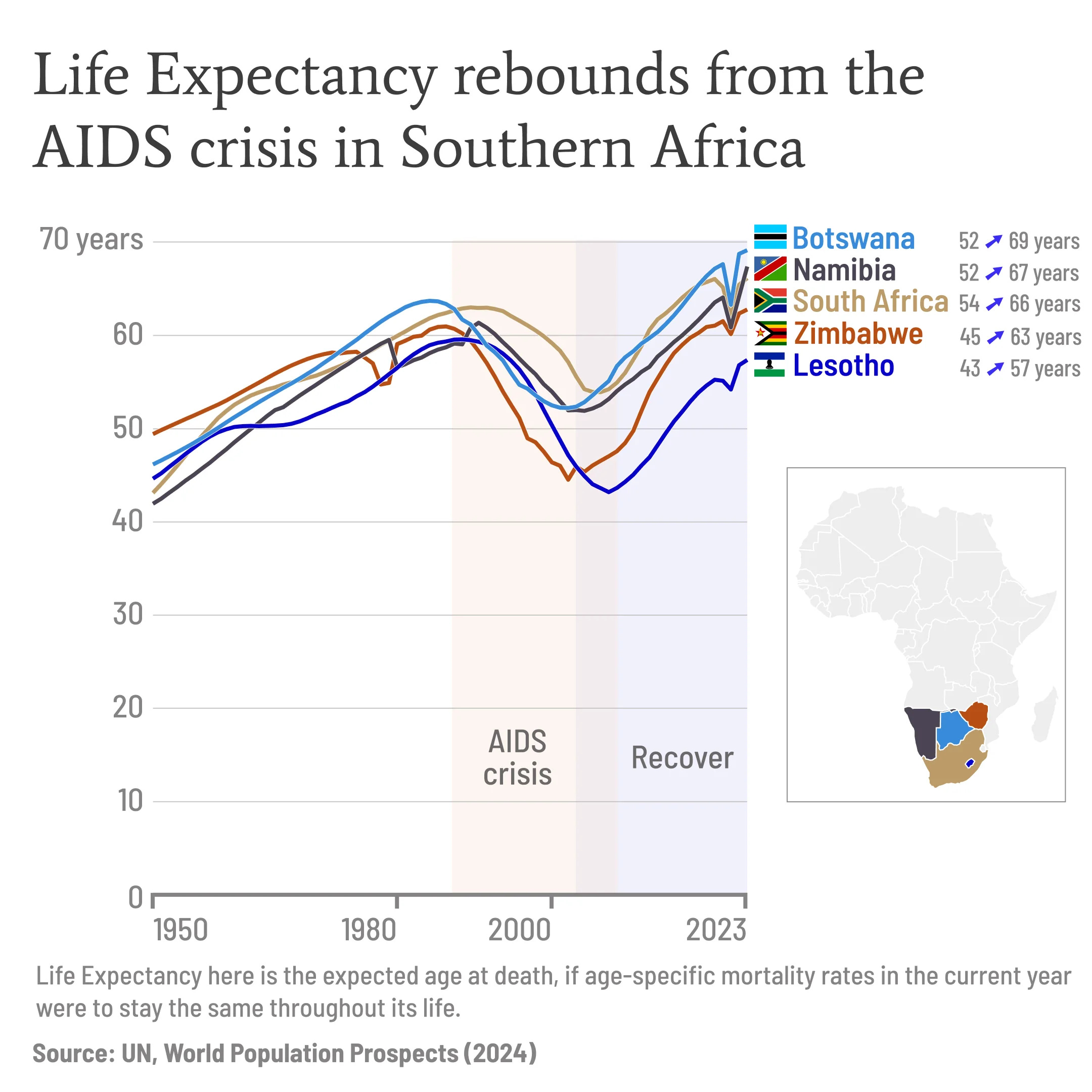
So healthcare in Africa is probably improving, but there was a temporary decline due to the epidemic. The analog here is COVID causing a small dip in global trends.
What does the future hold? Chinese:
Leaving the question of morality aside, there are good reasons based on national interest for the West to help. In the fractured world of Iran, Iraq and Afghanistan, Africa’s fragile and impoverished states are a natural haven for global terrorists. Porous borders, weak law enforcement and security institutions, plentiful and portable natural resources, disaffected populations, and conflict zones make perfect breeding grounds for all sorts of global terrorist organizations.
The four horses of Africa’s apocalypse – corruption, disease, poverty and war – can easily ride across international borders, putting Westerners at just as much risk as Africans. Of course, stolen money sent to European bank accounts can fund terrorist activities; disease, poverty and war induce waves of disenfranchised refugees and unchecked immigration, which can place inordinate burdens on Western economies.
The West can choose to ignore all of this, but, like it or not, the Chinese are coming. And it is in Africa that their campaign for global dominance will be solidified. Economics comes first, and when they own the banks, the land and the resources across Africa, their crusade will be over. They will have won.
Whether or not Chinese domination is in the interest of the average African today is irrelevant. This is not to underestimate how much Africans care about freedom and rights – they do. But in the immediate term a woman in rural Dongo cares less about the risk to her democratic freedom in forty years’ time than about putting food on her table tonight. China promises food on the table today, education for her children tomorrow and an infrastructure she can rely on to support her business in the foreseeable future.
The mistake the West made was giving something for nothing. The secret of China’s success is that its foray into Africa is all business. The West sent aid to Africa and ultimately did not care about the outcome; this created a coterie of elites and, because the vast majority of people were excluded from wealth, political instability has ensued.
This is amusing because Francis Galton famously wrote an essay about how the Chinese should colonize Africa -- Africa For The Chinese (1873):
The history of the world tells a tale of the continual displacement of populations, each by a worthier successor, and humanity gains thereby. We ourselves are no descendents of the aborigines of Britain, and our colonists were invaders of the regions they now occupy as their lawful home. But the countries into which the Anglo-Saxon race can be transfused are restricted to those where the climate is temperate. The Tropics are not for us, to inhabit permanently; the greater part of Africa is the heritage of people differently constituted to ourselves. On that continent, as elsewhere, one population continually drives out another. Consider its history as it extends over successive centuries. We note how Arab, Tuarick, Fellatah, Negroes of uncounted varieties, Cadre, Hottentot surge and reel to and fro in the struggle for existence. It is into this free flight among all present that I wish to see a new competitor introduced-namely, the Chinaman. The gain would be immense to the whole civilized world if we were to out-breed and finally displace the negro, as completely as the latter has displaced the aborigines of the West Indies. The magnitude of the gain may be partly estimated by making the converse supposition --- namely, the loss that would ensue if China were somehow to be depopulated and restocked by negroes.
The pressure of population in China is enormous, and its outflow is great and increasing. There is no lack of material for a suitable immigration into Africa. I do not say that it would be possible at any moment to persuade communities of men and women from Southern China to establish themselves in Africa; but I am assured, by excellent authorities, that occasions of political disturbances frequently arise when it would be practicable to do so by the promise of a free, or nearly free, grant of land. The Chinese have a land hunger, as well as a love for petty traffic, and they would find a field in which to gratify both of these tastes on the East African Coast. There are many Chinese capitalists resident in foreign parts who might speculate in such a system and warmly encourage it. If once successfully started, it ought to maintain itself. The colonist could not starve; and when they began to succeed they would send money to their relatives to enable them to follow, just as they now do from the many other parts of the world where they are located. For these reasons it is probable that the streams of emigration from China have sufficient “head” to enable them to reach and overflow the coasts of Eastern Africa if they were watched and judiciously diverted in that direction.
I have finally to speak of the political effort necessary to secure a free right of occupancy and of settlement at suitable points on the coast. No very serious obstacle seems to stand in the way; certainly none was met with when Liberia was founded. It is probable that as the success of such an enterprise would be of equally great value to all nations commercially interested in those parts, no national jealousy would be excited by its promotion, and the necessary territory could be obtained with little difficulty and at a small cost, to be advanced in the first instance as a charge on the land and hereafter to be redeemed.
Galton didn’t know it at the time, but some Chinese and Indians did eventually settle in Africa. Famously, they were later removed from Uganda (causing its economy to crash). This is a standard tale of expulsion of elite ethnic minorities and economic ruin to follow. Many such examples are covered by Amy Chua in her book World on Fire (2003), mainly based on Asia countries. It does not appear that non-Africans like living in Africa in large numbers given such experiences. The Europeans are draining out of southern Africa, Indians are out of Uganda etc. Now that most countries have far below replacement fertility rates, it is unlikely that anyone will settle Africa in large numbers. Rather, Africans will settle everywhere else, which we can fitting name Africa’s revenge or the Second Out of Africa theory.
Overall, it was a fun read, and provocative. I don’t know much about developmental aid except that it doesn’t seem to work (the economist literature largely agrees with this impression, though if you look around you can find positive and negative regression results). It’s not a rigorous science book, but it’s alright.
Good review. Appreciated inclusion of other sources on African dysfunction over time.
A huge part of the cause of African dysfunctionality is low average African IQ arising from genetic variation across ancestries. I can mention that causal factor on a Kirkegaard substack comments page, but it cannot be stated plainly in mainstream books and articles. The complete absence of that (partial but substantial) explanation makes it frustrating to read the academic literature in this area. Once you see it clearly, it is difficult to un-see it and read this stuff.