

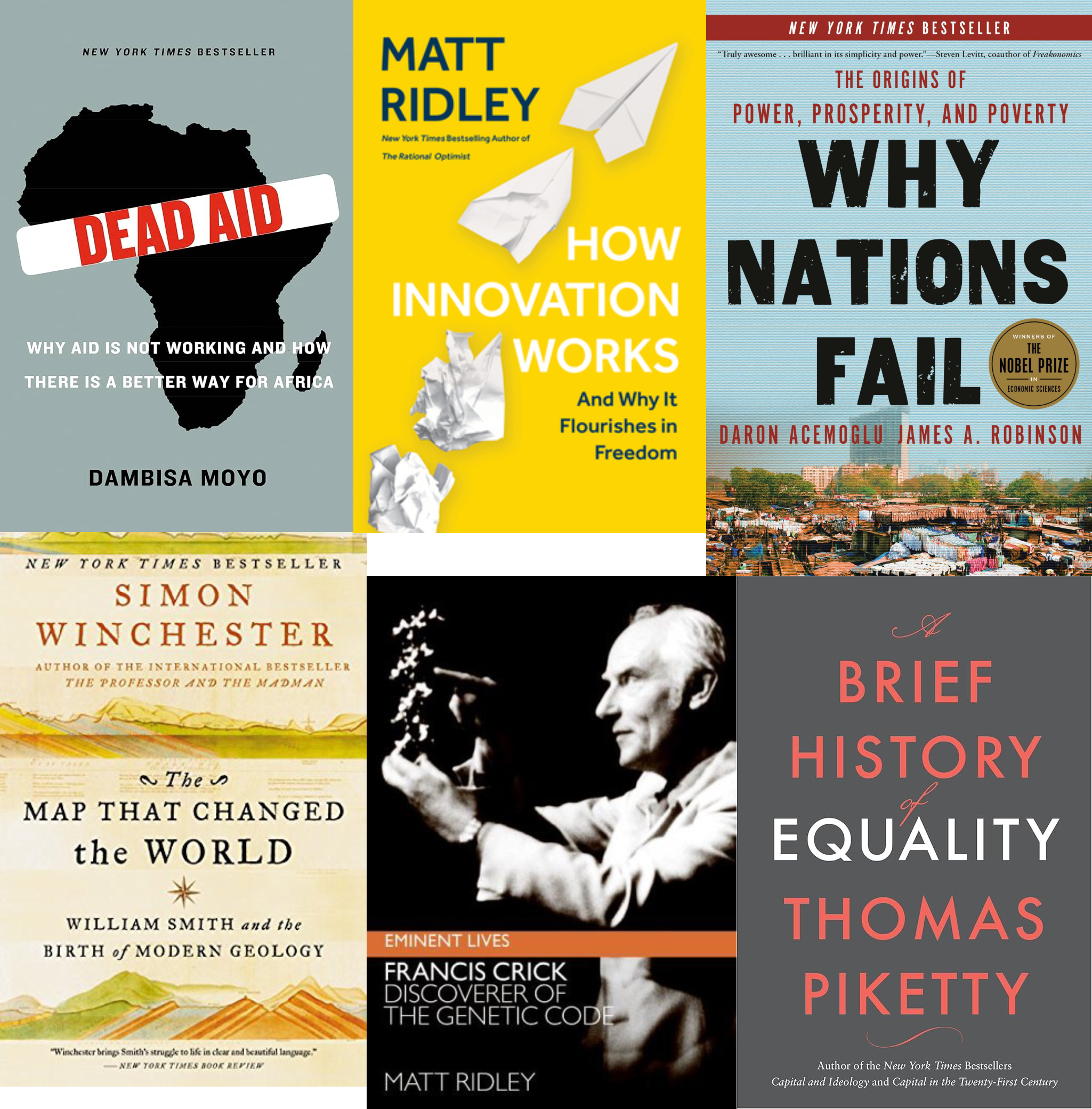
We continue the January book reviews. I had initially wanted to put them all in one post, but that would have been obscenely long given my notes. So we move on to book 2: Why Nations Fail: The Origins of Power, Prosperity, and Poverty, by Daron Acemoğlu & James Robinson from 2012. It’s another popular book that I had avoided since I thought it would be bad or at least not worth reading given it’s length (I only read books in their entirety). But since I decided to read some popular books, I read it anyway despite its length of ~550 pages.
It’s written by economists, so you would expect it has a lot of economic arguments, charts and so on. Just like the Thomas Piketty book does. But it doesn’t. It’s actually a history book. A prior set of reviewers summarized it this way:
Acemoglu and Robinson’s Why Nations Fail [2012] is a grand history in the style of Diamond [1997] or McNeil [1963]. Like those books, this book is exceptionally fun to read and full of interesting historical examples and provocative ideas. The basic theme of the book is that what matters most in why some nations fail – and others succeed, for the book is as much about success as failure – are not – as earlier authors have argued - economic policies, geography, culture, or value systems – but rather institutions, more precisely the political institutions that determine economic institutions. Acemoglu and Robinson theorize that political institutions can be divided into two kinds - “extractive” institutions in which a “small” group of individuals do their best to exploit - in the sense of Marx - the rest of the population, and “inclusive” institutions in which “many” people are included in the process of governing hence the exploitation process is either attenuated or absent.
I haven’t read Jared Diamond’s book either, but I’ve read Rushton’s review, so I can see indirectly the similarities. This book is a prototypical hedgehog book, as in, it has one single big idea and everything must be fit into that idea’s framework. In this case, it’s that some institutions are bad (’extractive’) and others are good (’inclusive’). I didn’t find any outright definition of this in the book, nor is any kind of measurement methods offered. Rather, it is a series of case studies of (mostly) Europeans setting up such bad institutions and the locals suffering as a consequence. Thus it is a kind of colonialism-theft bad theory. The closest to a definition of this: