

I regularly post in-depth book reviews, but I don’t review all books I read. This is due to some combination of sloth and them just not having enough quoteable content to be worth a post. Generally, I have been reading books on my tablet, but recently have gotten too lazy and now use almost only the ebook (non-pdf) reader on my phone. This allows for convenient note taking and marking passages for later writing.
Here’s a list of mini-reviews and my ratings of the books for the 25 books I read in 2025. I’ve sorted them by my Goodreads ratings. My rating scheme is: 5 stars = great book, highly insightful even if it has some flaws. 4 = no major issues, 3 = some issues, 2 = severe issues, 1 = unreadable. The rating distribution is skewed towards the high end for the obvious reason that I don’t generally read books I anticipate being a waste of time.
5 star books (8 books)
Permanent Record, Edward Snowden, 2019
With Russia’s war, things aren’t looking great for Snowden. However, his role in disclosing the government spy programs was extremely important. If there is any person Trump should pardon, it is him. The book gives his version of the story, which was later made into a movie.
The Network State: How To Start a New Country, Balaji S. Srinivasan, 2022
A bold book on building new countries or country-like entities in the modern world. The author isn’t just a larper, he’s currently making at attempt at this in Malaysia near Singapore (Network School). I havne’t visited yet, but I will when the opportunity comes.
Medical Nihilism, Jacob Stegenga, 2018
A book arguing that most of medicine is bunk and things are harder than you might think. I wrote a detailed review.
The Wages of Destruction: The Making and Breaking of the Nazi Economy, Adam Tooze, 2008
Very insightful book on semi-modern warfare (WW2). It’s mostly a numbers game.
How the War Was Won: Air-Sea Power and Allied Victory in World War II, Phillips Payson O’Brien, 2015
Similar to the above, but with a focus on the relative importance of air power.
Immune: a Journey into the Mysterious System that Keeps You Alive, Philipp Dettmer, 2021
From the main writer of Kurzgesagt (probably the best animated science channel). I initially got this when COVID hit, figuring I should learn more about the immune system. Then I forgot to read it, well, until 2025 when COVID was over. It’s pretty funny and tries to explain the various components of the immune system. Yes, it’s one of those biology books that people complain about with memorization of 17 different cell types.
The Rationality Quotient: Toward a Test of Rational Thinking, Keith E. Stanovich, Richard F. West, Maggie E Toplak, 2016
Can one make a rationality test? The authors boldly tried to do so. Mostly they recreated a general intelligence test that is much slower to administer. Still, there is something more to rationality than mere intelligence. It’s just hard to measure well. Stanovich and co are the other people seriously trying to do this. The book covers the various tests they included in their battery, and their validation studies. Missing from this is any evidence that this rationality factor predicts anything beyond g.
Marx: A Very Short Introduction, Peter Singer, 2018 (2nd. ed.)
Highly amusing review of Karl Marx’ life and works. It’s hard to find anything of much value in his thinking as a scientist, though his influence can’t be denied. I wrote a review with the best parts.
4 star books (14)
QI : Des causes aux conséquences: De la génétique au capitalisme cognitif, Philippe Gouillou, 2024
I can’t actually read French, but the author sent me an English language version. It was an OK summary of current research.
Collapse: The Fall of the Soviet Union, Vladislav M. Zubok, 2021
A narrative account of the fall of the Soviet Union. Mostly it’s a history of Gorbachev’s last few years in power.
Enlightenment Now: The Case for Reason, Science, Humanism, and Progress, Steven Pinker, 2018
Not too much wrong with it. If you want a detailed criticism, then see the Sarraf/Woodley reply book, which I also reviewed some years ago (but where is that review?).
Propaganda in the Information Age: Still Manufacturing Consent, Alan Macleod (editor), 2019
It’s essentially a restatement of Chomsky’s prior book, but still suffering from the problem of how to make it make sense that the right-wing is in power. It had some good parts. The general thesis that the media manufactures consent is basically right.
Race to the Bottom: Uncovering the Secret Forces Destroying American Public Education, Luke Rosiak, 2022
One of the many anti-Woke books, giving a history of American education issues.
Intelligence Men: Makers of the I.Q. Controversy, Raymond E. Fancher, 1985
A classic biography book of key human intelligence researchers. Some of this is now outdated but it was still interesting.
The Unprotected Class: How Anti-White Racism Is Tearing America Apart, Jeremy Carl, 2024
Another of the anti-Woke books, this one with a focus on the mainstay of woke, which is White self-hatred.
Liberal Bullies: What Psychology Teaches Us about the Left’s Authoritarian Problem―and How to Fix It, Luke Conway, 2024
Another one, but this one tries real hard to lean towards the center. More academically minded.
Family Unfriendly: A Critical Examination of Overparenting and Its Consequences, Timothy P. Carney, 2024
I became a father last year, so I figured I should read some parental books. This one is in line with Bryan Caplan’s Selfish Reasons to have more children (which I didn’t read so far). The main content are tips and tricks to make parenting life easier.
Why Machines Will Never Rule the World: Artificial Intelligence without Fear, Jobst Landgrebe & Barry Smith, 2025 (2nd. ed.)
A contrarian book arguing that LLMs won’t achieve general artificial intelligence because such a technology is impossible to build. I wrote a lengthy review and had a debate with the authors over on Aporia.
China After Mao: The Rise of a Superpower, Frank Dikötter, 2022
Another Chinese history book by Dikötter. I think the trilogy was better, but I’m still missing the first book (The Tragedy of Liberation). I guess I can read it this year.
Nobody’s Fool: Why We Get Taken In and What We Can Do about It, Daniel Simons, Christopher Chabris, 2023
Fairly typical book covering the current mistakes in thinking regarding science. Chabris is a fairly reasonable fellow, so I expected it to be half-decent, which it was.
A World after Liberalism: Philosophers of the Radical Right, Matthew Rose, 2021
A history and biographical sketch of various far-right thinkers. I am not really into verbal tilt political theory, so I figured this might fill some gaps.
Looking Down on Human Intelligence: From Psychometrics to the Brain, Ian J. Deary, 2000
Ian Deary is probably the most influential currently living human intelligence researcher. Despite not being so old at the time, he wrote a curmudgeon book already 25 years ago. It’s mostly useful for its history chapters.
3 star books (2)
The Genetics of Political Behavior, Michael Ryan, 2020
This book is unhinged but funny. It’s what happens if one combines Wokism with evolutionary psychology’s worst just-so story approach. I reviewed it in detail.
The Constitution of Knowledge: A Defense of Truth, Jonathan Rauch, 2021
Sketchy, and not as good as his earlier free speech book.
2 star books(1)
DNA, Race, and Reproduction, Emily Klancher Merchant (Editor), Meaghan O’Keefe (editor), 2025
A fairly typical Woke book on genetics. Full of errors, of course. I reviewed it.
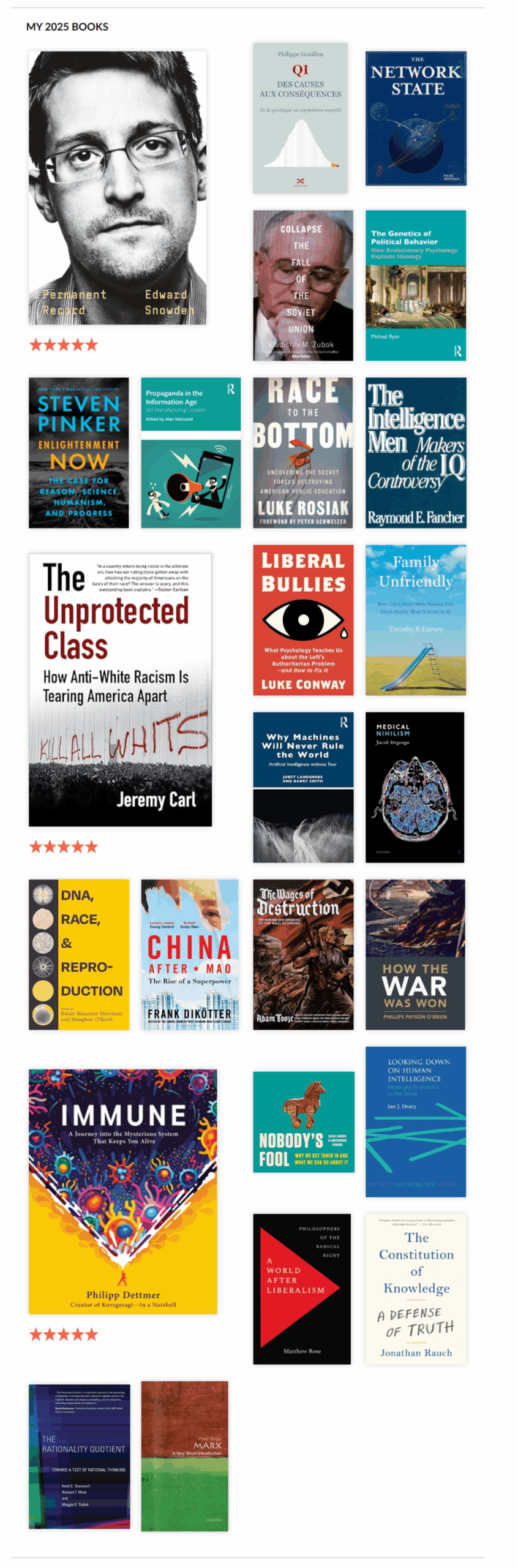
Or in a picture:
A word of warning about Frank Dikötter, the author of 'China After Mao: The Rise of a Superpower', by Chinese historian Dongping Han: "I have some dealings with this guy. Many years ago, someone in Malaysia wrote to me about his book, using the 1947 Life Magazine Photos as his front page cover and claiming that he has evidence to prove that Chairman Mao wanted to starve half of the Chinese people. He asked me to do something about it.
So I wrote to him about this. He said that he could not find any pictures of the Great Leap Forward, therefore he had to use what he could find. There goes his academic honesty! I asked him to share his evidence. He said that he can not reveal that evidence because he had a confidential agreement with the source. I said that you could not do that. He said if I came to his office in Hongkong, he would let me look at it. I could not go to Hong Kong, so I asked a friend to see him.
It turned out that the evidence he had was Chairman Mao's speech about the national investment projects. Chairman Mao said that he wanted to cut the national investment projects by half. so that the remaining half would get enough money to complete in time. He either did not understand the Chinese language or he was maliciously misleading the reader. He got two and half million dollars from Jiang Jingguo Foundation in Taiwan for his book."
That Genetics of Political Belief book is something else! 😂😂😂