

Richard Lynn noted a ‘paradox’ or incongruency many years ago (1994):
A paradox concerning sex differences in intelligence and brain size has recently been noted by Ankney (1992) and Rushton (1992). This is that males have on average larger brains than females, even when adjustments are made for body size, and brain size (whether or not adjusted for body size) is positively associated with intelligence. From these two propositions it would be expected that males would have a higher average level of intelligence than females. Yet it is invariably stated in text books that “gender differences in general intellectual ability are small and virtually non-existent” (Brody, 1992, p. 323) and “there are no overall differences in the scores obtained by males and females on intelligence tests” (Halpern, 1992, p. 63). There seems to be a logical inconsistency between the findings of the larger male brain, the association of brain size with intelligence and the absence of a sex difference in intelligence which calls for resolution.
Ankney and Rushton propose different solutions to the paradox. Ankney accepts the generally held view that there is no sex difference in general intelligence, and he also notes another generally accepted view that females obtain higher means on verbal abilities while males obtain higher means on spatial abilities (e.g. Maccoby & Jacklin, 1974; Hyde & Linn, 1988; Linn & Petersen, 1985; Halpern, 1992).He apparently accepts that these relative male and female strengths in the verbal and spatial abilities are counterbalanced so that they produce equal overall intelligence. The solution he proposes to the paradox is that spatial ability may require more brain tissue than verbal ability. This is an ingenious solution but there is no direct evidence to support it and there may be a simpler solution to the problem.
Such a simpler solution is proposed by Rushton. He questions the belief that males and femaleshave the same mean IQ. He cites the results of the standardization samples of the WISC-R in the United States and Scotland (Jensen & Reynolds, 1983; Lynn & Mulhem, 1991), in both of which malesobtained slightly higher means for Full Scale IQ than females. However, the proposition that males have a higher mean IQ than females runs counter to the consensus of opinion in the entire history of intelligence testing and would certainly require the marshalling of a considerable amount of evidence to sustain.
That, is, men have ~1.4 SD advantage in brain volume (UKBB results):
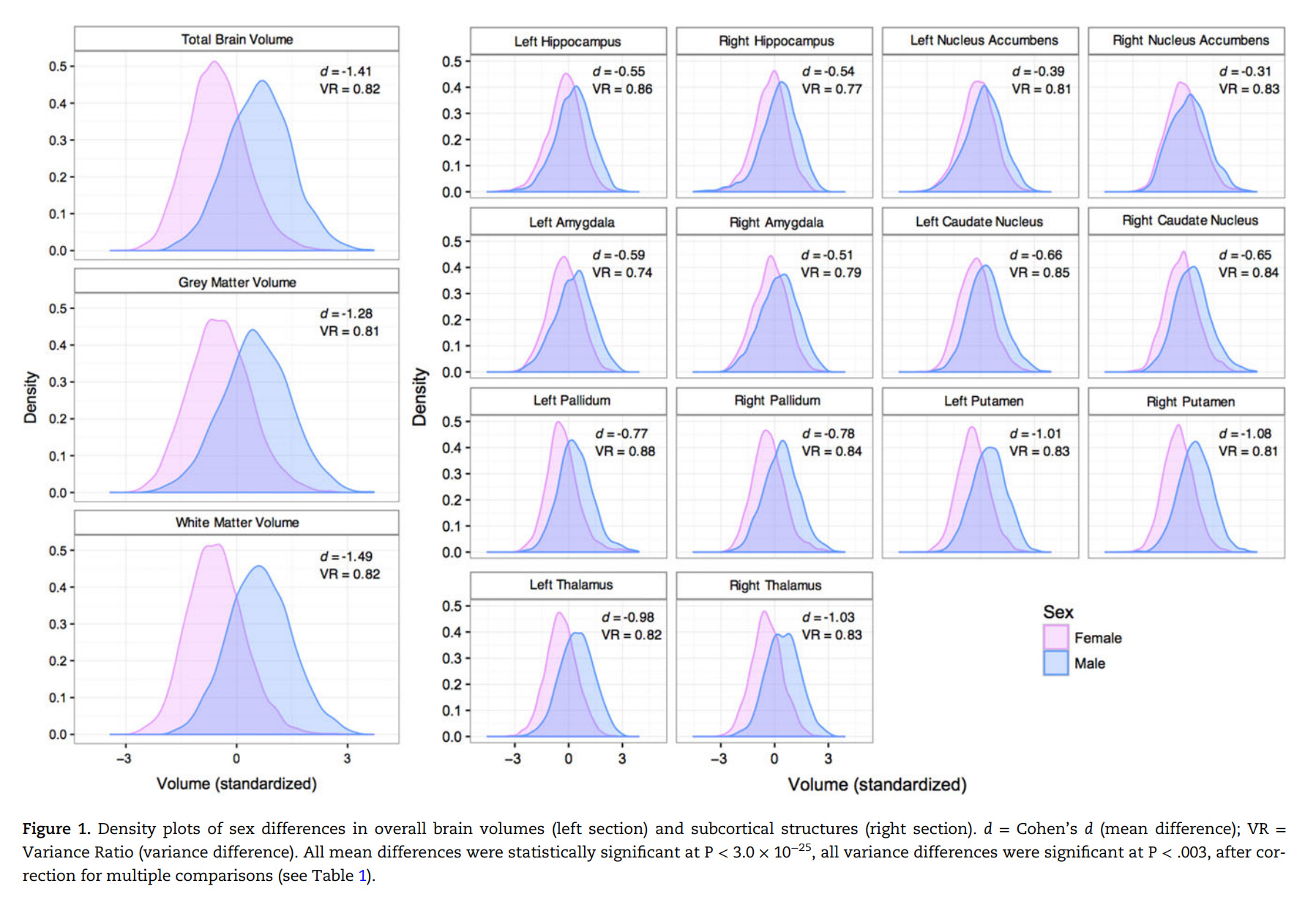
Intelligence correlates something like 0.30 with total brain volume, which we can assume is mostly causal (TBV -> intelligence). Thus, putting these numbers together, we get the expectation that men should be -- all else equal -- 1.4 * 0.3 = 0.42 d smarter, or 6.3 IQ. Actually, the 1.4 brain volume gap includes indirect effects of men just being bigger in general. Ritchie et al noted:
We also ran analyses adjusting for height, since overall body size may have influenced these differences (as expected, males were substantially taller on average: d = −2.15). This attenuated all of the d-values (average attenuation across global and subcortical measures = 71.3%), but males still showed significantly larger volumes for all subcortical regions except the nucleus accumbens (Table S1). For example, post-adjustment d-values were −0.42 for total brain volume, −0.31 for grey matter volume, and −0.47 for white matter volume.
Thus, one may want to use the 0.42 d instead, which leads to the expectation of a 0.13 d or 1.9 IQ gap. These corrections depend on how one thinks the causality works out. The height correction applied were was probably linear (the supplements don’t say), whereas biometric scaling usually shows nonlinear patterns, which is why calculating encephalization quotients requires a large sample of species-like units. Anyway, no matter the exact method, there is some expectation of a male advantage somewhere around 1.9 and 6.3 IQ. By the way, in the same UKBB study, men scored 0.18 d higher on the verbal-numeric reasoning test, and had 0.21 d faster reaction times, equivalent to about 3 IQ.
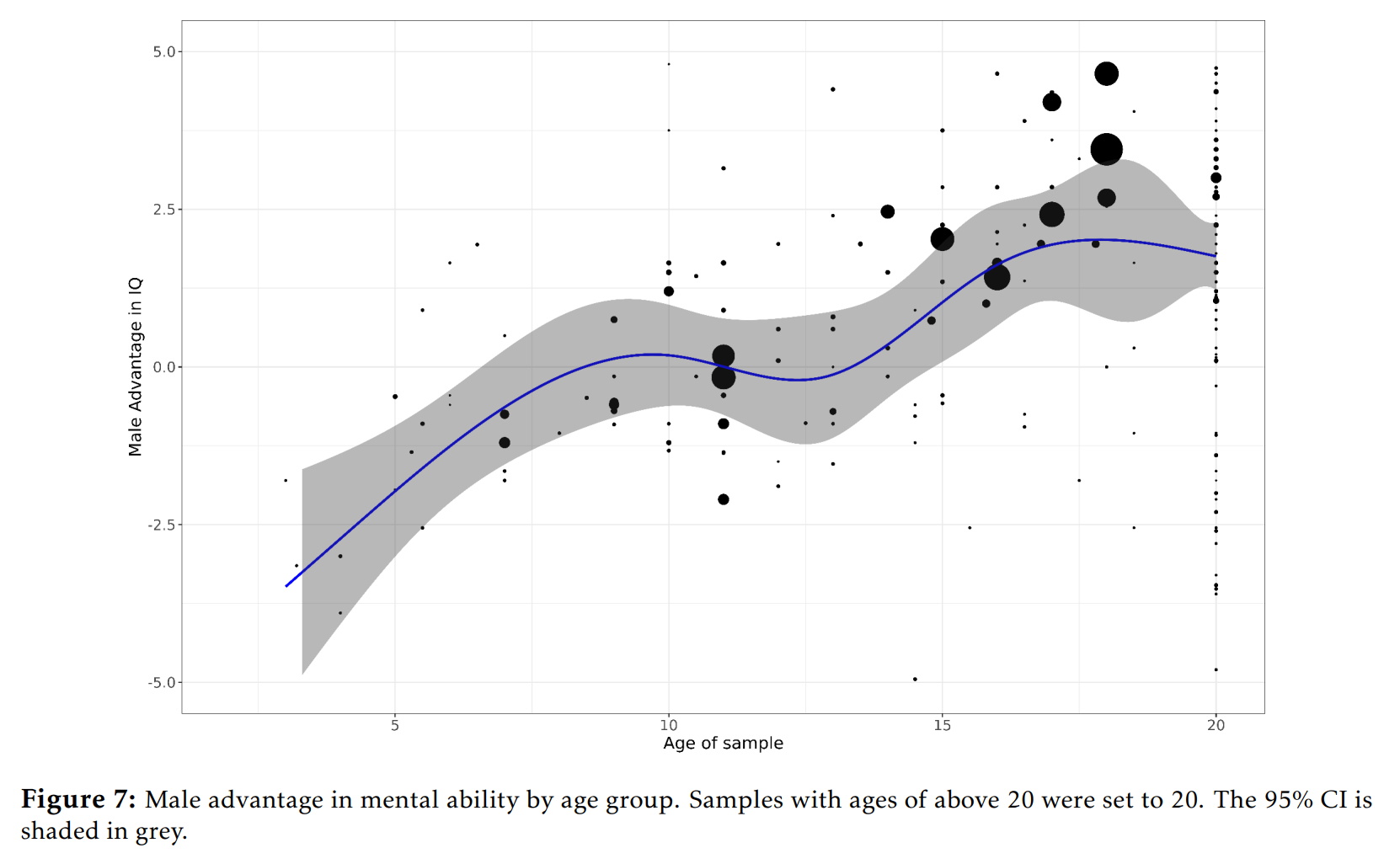
Lynn’s proposed solution to this was simply that the textbooks are wrong, and men are actually a little smarter than women. He then proceeded to spend a few decades compiling evidence of this in the form of meta-analyses. He finally found something interesting, which is that the male advantage grows with age, starting in the later teens, and with some samples showing girls are favored at young ages. Furthermore, since most datasets come from school children, this explains why most studies had missed the male advantage which can only be seen for older ages. This is called Lynn’s developmental theory, which he summarized in a book (2021) shortly before his death (2023), and also in a review paper in MQ (2017). Parra and I decided to redo and expand his meta-analysis, and our study was just published. Steve Sailer somehow scooped us on reporting our own work, but I guess that’s a good thing. Meng Hu posted it on X. The main figure is this one:
Parra, L., & Kirkegaard, E. O. W. (2026). Meta-analysis of sex differences in intelligence. OpenPsych. https://doi.org/10.26775/op.2026.03.10
There is no consensus within the field of psychology on whether there are sex differences in intelligence. To test whether there are, 2,092 effect sizes were gathered that measured differences in mental ability between men and women, representing 15,990,325 individuals. Men scored 2.57 IQ points (95% CI [1.91, 3.23], I^2 = 98.2%, k = 47) above women on general ability tests within adults. Whether this difference is due to general intelligence (g) is not clear, though it is likely. Two of the three methods used to test the developmental theory of sex differences suggested that the male advantage in ability increases with age.
The meta-analysis included many large samples, such as OECD’s PIAAC adult PISA-like testing. Overall, the adult gap was about 2.5 IQ. It varies by test type:
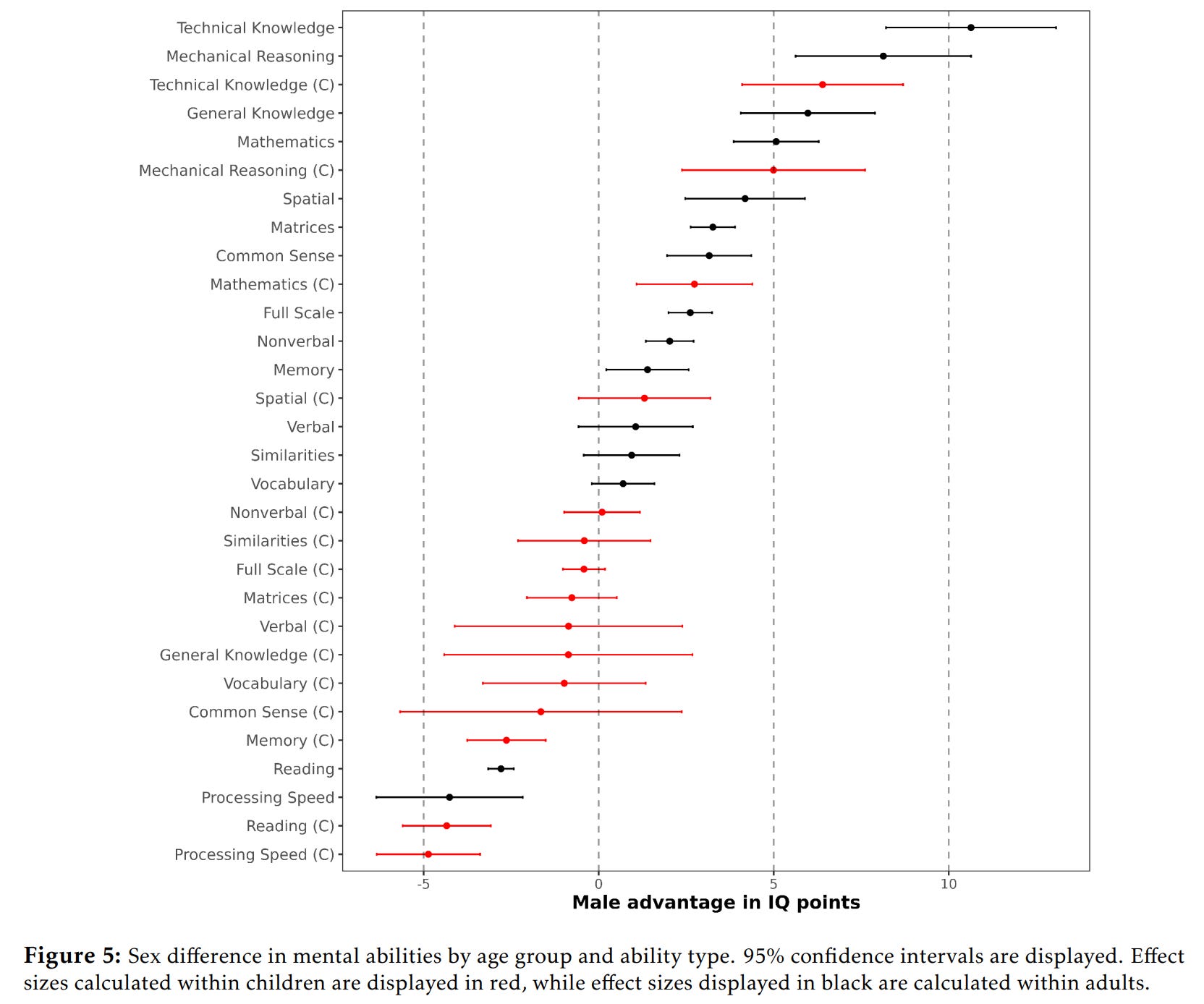
Given this variety of gap sizes by type, one can build a battery of tests with a desired gap or no gap (e.g., if you want a female advantage, fill it with reading and processing speed type tests). One can even fiddle with the items inside tests to prune them of problematic male-favoring items. This has been done for many years, and I don’t know if it is still done. Then there is the matter of reliability of the scores. The observed gap of 2.5 IQ would be slightly larger if adjusted for reliability, but probably not more than 3 IQ as most of these general scores were from fairly reliable composite scores. The main problem with the meta-analysis is seen in the funnel plot:
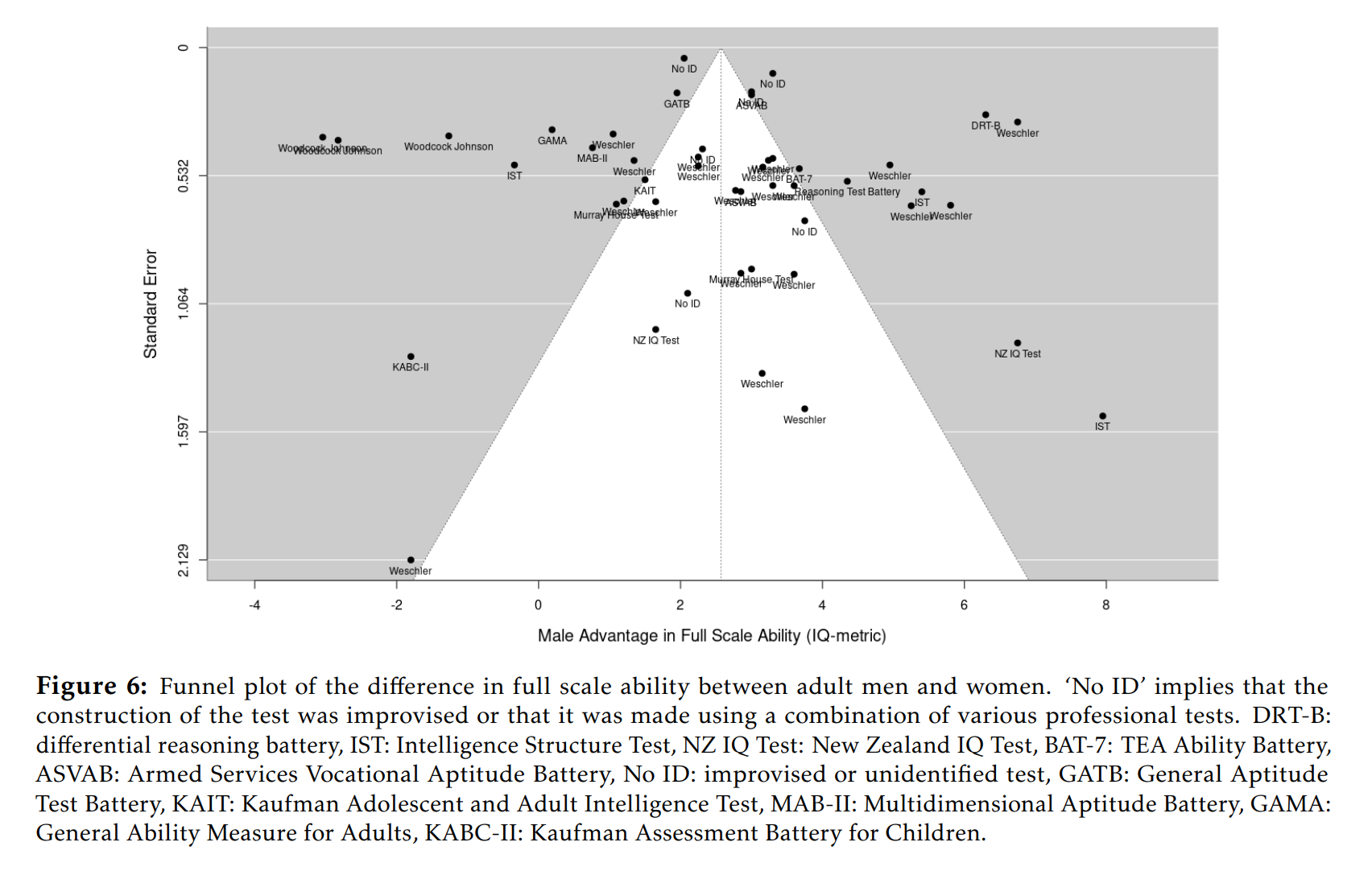
The normal issue apparent when looking at funnel plots is that they show publication bias, that is, smaller studies tend to favor one direction of results which is what the results want to find or report. This one does not show much evidence of such bias, rather the issue is that very large studies don’t agree enough with each other, which is to say, differences in results between large studies cannot be explained by random sampling error, but must be due to systematic differences. These presumably mainly concern the kind of tests used in the study, and sometimes the particular scoring method used (custom composite index a la Wechsler vs. PCA vs. CFA vs. unweighted mean).
The developmental model of the sex difference in intelligence, while it resolves one problem (Q: why aren’t men smarter if they have bigger brains? A: they are), it adds a new one: boys also have bigger brains than girls, not just adult males than adult females or older juveniles, but no testing shows young boys to be smarter. If anything, the testing shows girls to be smarter, below age 8 in our results this was also found. One then has to come up with a new theory for why this end of the age spectrum shows a female advantage despite a smaller brain size. The sensible guess is that it has to do with maturation speed (life history speed), in which girls have an advantage. But this is just speculation.
There are two other issues remaining. First, measurement schmeasurement. I know Cremiuex has been talking about his pet topic of doing the latent models (MGCFA). I’ve done latent models in the NLSY using the item data (IRT + DIF), and I find there is no bias here and the advantage for males increase with age on the g factor. I’ll report these results in a future post. Second, sampling bias. It is possible to claim that the male advantage that shows up in later ages is because dull men aren’t included, which is to say that there is a sex * intelligence * age interaction for study drop-out. I am not normally keen on interactions and definitely not triple interactions, but it can be examined. For instance, such selective drop-out should show that the sex difference in variability (variance) decreases with increasing age where the male advantage shows up. This sounds like something that has already been disproven somewhere, but I will have to look again.
Analyses on the impact of selection bias on sex IQ gap has been done before, as I noted in this paper "The issue of self-selection has been raised as a confounding factor in testing Lynn’s hypothesis because women are more likely than men to participate voluntarily in surveys. Dykiert et al. (2009) argued that Lynn’s developmental theory of sex difference is difficult to test properly due to selection bias that is more pronounced in adult samples, as children are easy to sample because all children must attend school while adults are more autonomous in their decisions: “Researchers must address the problem of non-inclusion of a proportion of their target population because there are systematic differences between those who choose to take part in studies and those who do not. These disparities may, and almost obviously do, bias the findings of studies on sex differences in intelligence, since it appears that both gender and intelligence may influence one’s decision to participate.” (p. 43). Their literature review, along with their analysis of the BCS, found evidence that attrition effects in follow-up waves caused a distortion in gender ratio, IQ means and variances, ultimately resulting in a higher female to male ratio, higher IQ for the remaining subjects, higher IQ variance for males, higher IQ means for males compared to females. Yet the sex IQ gap does not vary across ages, with a male advantage of 1.21, 1.79 and 1.39 IQ points at age 10, 26, and 30, respectively. A better method to estimate attrition is by way of logistic regression, proposed by Hunt & Madhyastha (2008), and which calculates the probability of participation in the follow-up depending on cognitive ability. Using this method, Madhyastha et al. (2009, Tables 3 & 6) analyzed the BCS and the NCDS data but found that the distortion, owing to differential attrition rates, on the male-female IQ is extremely small among adults. Even more troublesome is that Lynn & Kanazawa (2011, Tables 2-3) actually analyzed the NCDS among adolescents and found a very slight female advantage at age 7 and 11 but found a male advantage of 1.8 IQ points at age 16 as well as a consistently larger SD of males’ IQ regardless of age. Because the pattern is similar whether the entire sample at each wave is analyzed or whether a restricted sample that completed all surveys is analyzed, they effectively ruled out the attrition effect as a possible explanation for the developmental theory of sex differences. Taken together, it would seem that the impact of differential attrition is unlikely to account for much of the observed gender full scale IQ difference, because this gap typically amounts to 5 points (Lynn & Irwing, 2004).
Perhaps, as a result, there is no definitive conclusion on sex differences in general ability. Differences in age, attrition effect and methodology across samples, however, do not explain why there is a general agreement in sex differences in specific abilities but not in general ability (Reynolds et al., 2022)."
I don't know why this data has been missed or ignored, but tens of millions of teenagers, generally 17 or 18, who want to attend college take the SAT, administered by The College Board, and the resulting data stretches more than 60 years...The SAT is divided into a Verbal section, which covers every kind of language skill, and Mathematical, which is self explanatory....Over hundreds of millions of tests, boys are very slightly better than girls in language skills, but are markedly better in Math skills...On average, therefore boys are about 4 IQ points ahead of girls on average at that age...This correlates well with the brain growth theory...