

There is a recurrent feature of the immigration debate that goes like this:
Emil: Look at how negative the fiscal contributions of 3rd world migrants are.
People: Heh, that’s nice, however, moving low skill labor into your country allows [the natives to specialize in higher paid jobs/people to trade more], so actually the total effect is positive even for the citizens.
Lyman Stone provides a recent example of the 2nd variant (Stone is usually handy for getting good quotes of crazy views).
In reality, the wealth and general development of a country has not much to do with the population size at all but with the distribution of human capital. That’s why the global inequality plot looks like this:
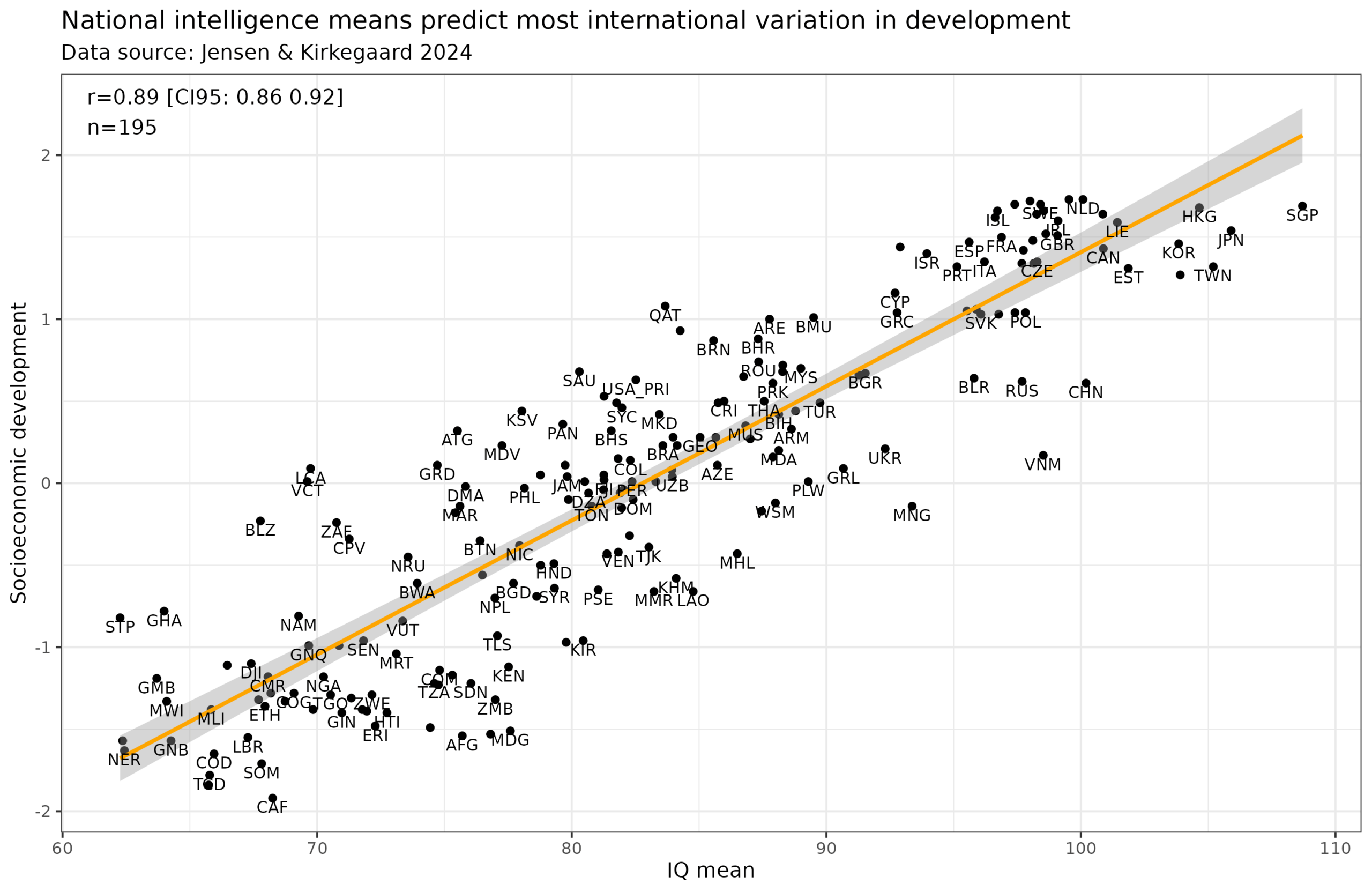
But let’s go further. The point about the economic effects of migrants is split into people arguing for these two metrics:
Effect of migrants on the entire host economy, usually in per capita terms, and especially the effect on the natives.
Effect of migrants on the host’s government budget.
The second option can be estimated by adding up all the tax payments and all the costs on a personal level, and then summing these. This is what the Danish finance ministry did a number of times, and a variety of (researchers in) other countries have since produced similar estimates (Netherlands, Finland, USA, maybe others). In fact these estimates are based on a first-order effects only model. Theoretically, migrants could cause natives to be more productive because of [food delivery/doing bad jobs/magic]. This would still result in them having a net negative government budget effect but the total effect could be positive. But it’s just a could. It could also be more negative if they have further negative externalities such as undermining cultural norms, causing productivity reducing internal migration, weakening democracy, causing the need for stricter but expensive law enforcement/insurance. Most of these factors are also not included in the government budget calculations (law enforcement costs are included), for how could they be quantified?
Therefore, in practice, a sensible guiding assumption is that the total effect of migrants on the economy (in per capita) is proportional to their effects on the government budget. Everything else devolves to hand-waving about the hard-to-estimate benefits/costs to [your favorite examples]. Here’s my favorite: from a market perspective, in general, if a group is net negative for the state’s budget, they are likely to be net negative for the economy as a whole because when the state runs a deficit, it has to raise more money in some way or another. It will be loans, inflation, or taxes, all of which are bad for the productivity of the existing population and will lower their productivity.
Could we nevertheless attempt to study some of these hypothetical effects? Well, if more people is just better in general because of [increased trade/specialization], then countries with larger populations should be better due to the benefits of scale. Of course, someone else could equally well speculative about negative effects of scale such as [increased difficulty of effective governing]. I don’t see any robust ways to study the other hypotheticals such as migrants magically making the locals more productive.
Anyway, here’s the worldwide correlations between population size and various country-level metrics:
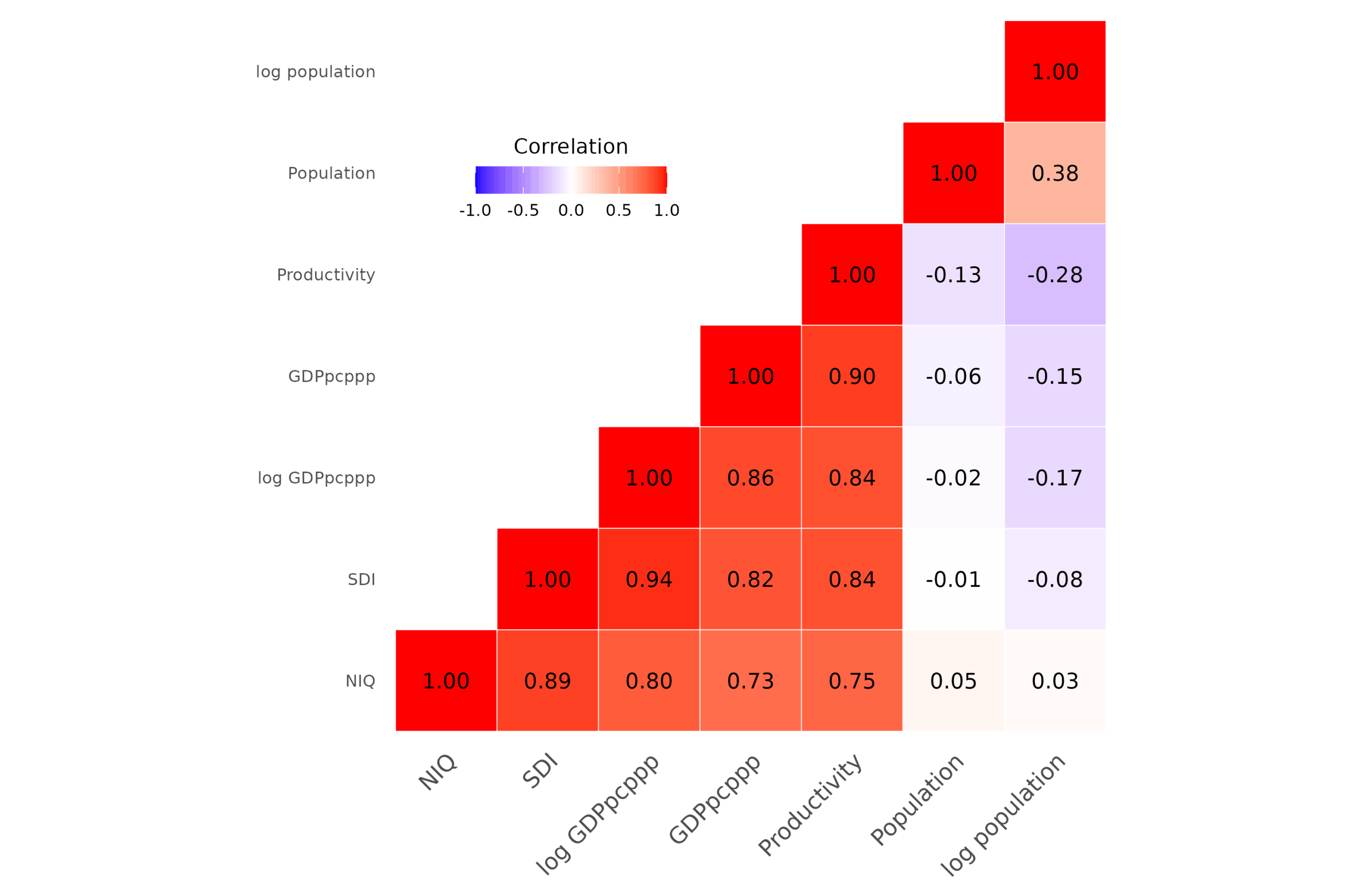
If anything, population size has a bit of a negative correlation. And we remember from the last post that while seeing a correlation between X and Y does not mean X causes Y or Y causes X, seeing no correlation in general means that neither causes each other, since absent rare causal paths, causation results in correlation. In a plot:
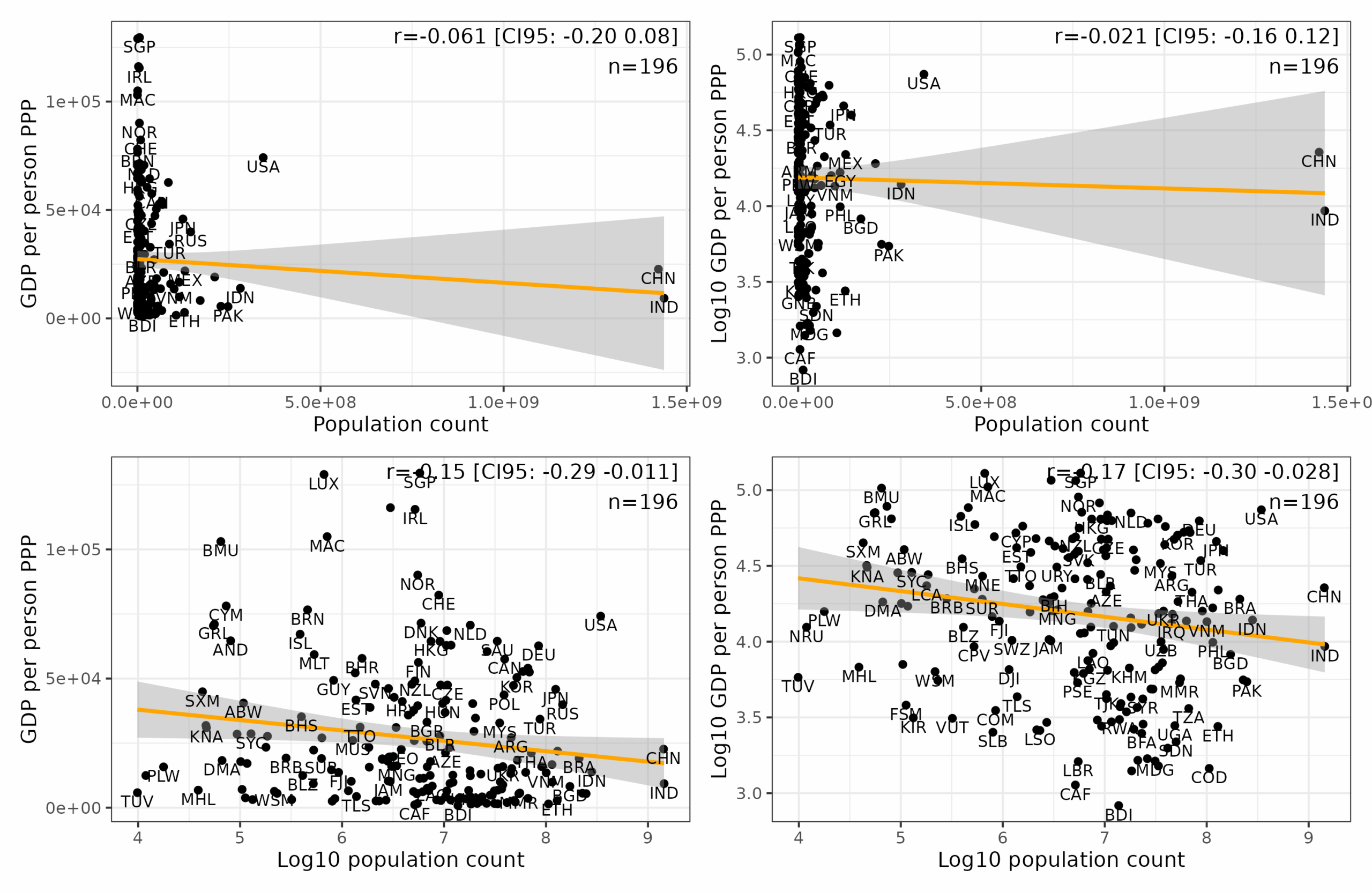
It’s not looking fantastic. But maybe there is some effect of population size net of IQ? I downloaded data for some popular metrics: productivity (GDP/hours worked), GDP per capita PPP, worldwide general socioeconomic scores and ran the regressions:
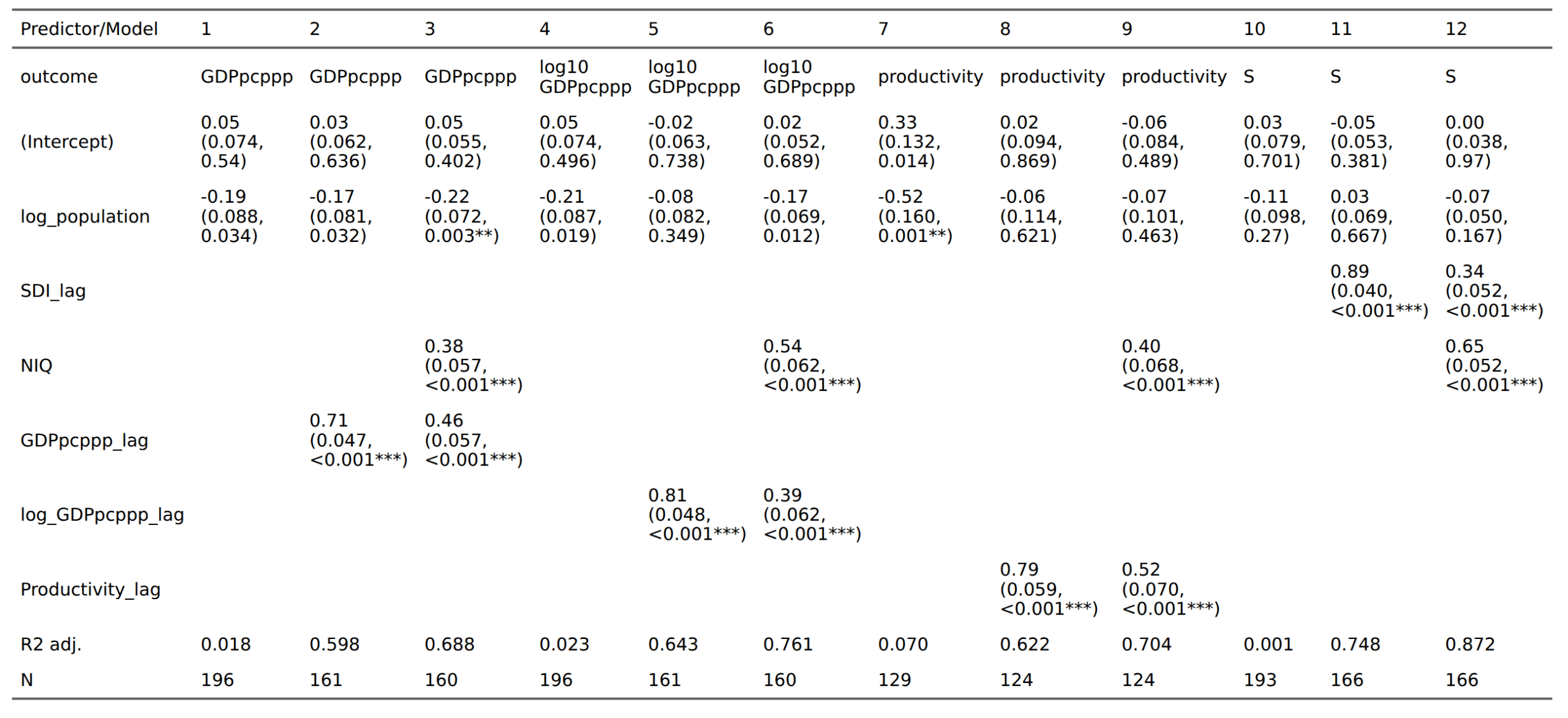
Betas are standardized for comparison. I have included spatial lags for those concerned with confounding. In none of the 12 models does population predict anything positive, and in 6 models the beta is p < 5% negative.
OK, but maybe this cross-sectional approach is too crude. We should look at economic growth in a time series model, or something more fancy. Yes, maybe one could squeeze something out. I note here that our earlier study of economic growth using Bayesian model averaging also found no effects of population in any of the models:
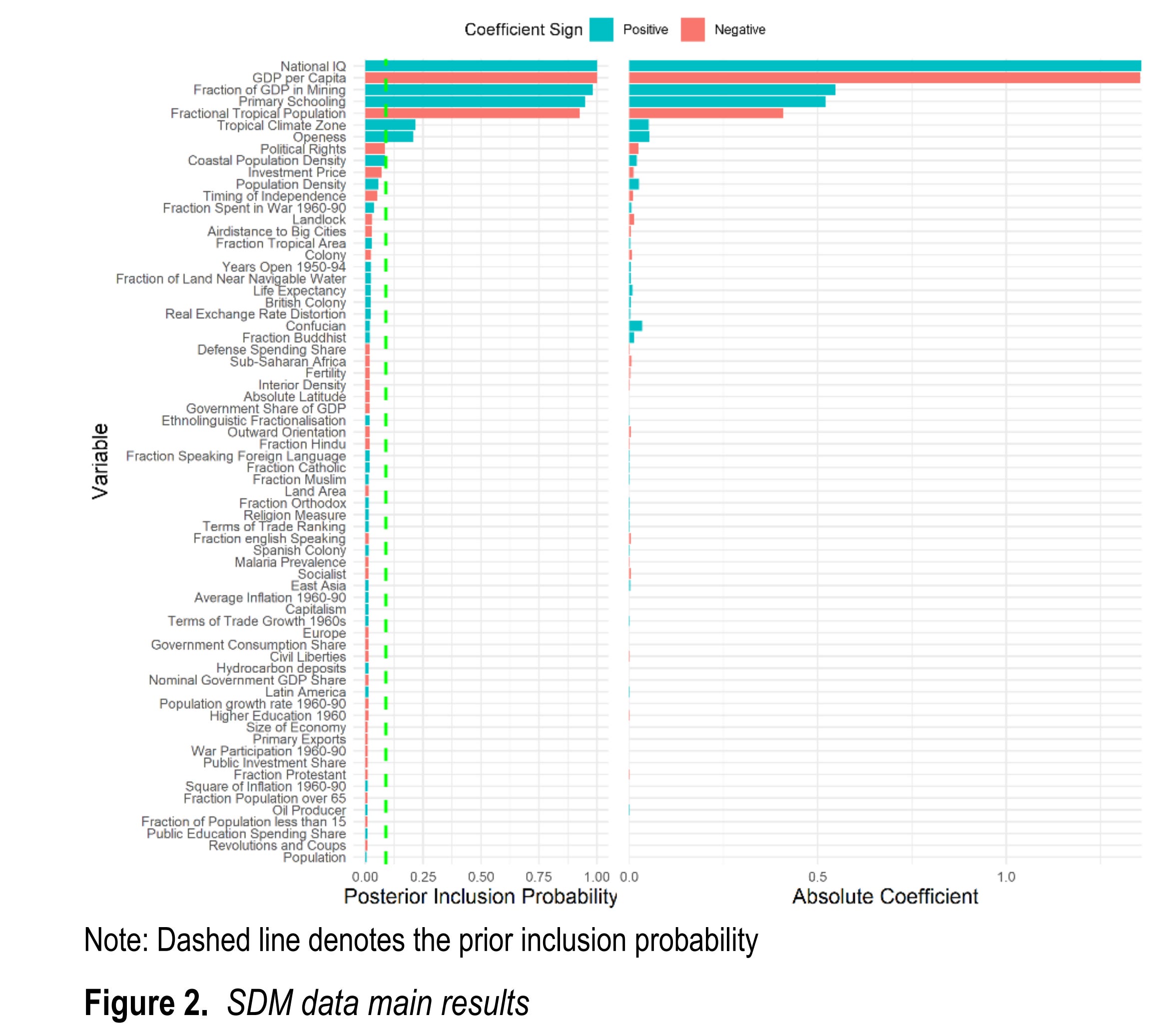
As a matter of fact, population size was the worst predictor of all the ones tried. Note that GDP per capita in the 2nd row is the initial value in 1960 (to capture the catch-up/advantage of backwardness effect).
What about studying effects on productivity of natives of population size changes due to migration? Well, it is difficult to get such data. And second, the problem is that there is a lot of different migrating happening at the same time. A country with good economic growth (e.g. USA) will attract migrants (thus, GDPpc causing population growth), creating a positive correlation. In the same way, bad countries cause people to leave [anywhere with communism, most 3rd world countries], again resulting in a positive relationship over time for some countries. One could theoretically look at large-scale movements of people from historical resettlements/expulsions, but these usually relate to war so may not be quite optimal. Maybe looking at countries that split up or merge is more sensible (e.g. Czechoslovakia, West & East Germany, Yugoslavia), but since most of these relate to out-of-communism transitions, again it is difficult.
This sounds like a problem for which causal discovery would be a good solution. Is there a way to download a clean comprehensive dataset including all the variables of interest?
"In reality, the wealth and general development of a country has not much to do with the population size at all but with the distribution of human capital."
In reality, the wealth and overall development of a country have little to do with population size at all, but rather with the quality of human capital.