

In a world of declining fertility, we have to ask ourselves why it is so declining. I’ve spent many posts on that question. We could also ask instead, how do I avoid this happening to me? Since more readers are male here, we can assume a male perspective (sorry ladies). Adults generally pick some kind of occupation and stick with it or closely related ones throughout their careers -- call this the occupation stability assumption. This makes it possible to group women into all of these occupational categories and ask which ones are likely to give you more children. Using the very large US census surveys, it is possible to estimate these occupation-level fertility rates. The question used is the simple question “In the PAST 12 MONTHS, has this person given birth to any children?”. Thus, every woman answers yes or no, and we can compute the age standardized average. The age standardization works simply by computing the total female mean for a given age (or bracket), then scaling the numbers to the relative rate (average = 1). Then do the same thing for each age and finally average the values using weights for the number of women in each. Doing this exercise produces this set of results:
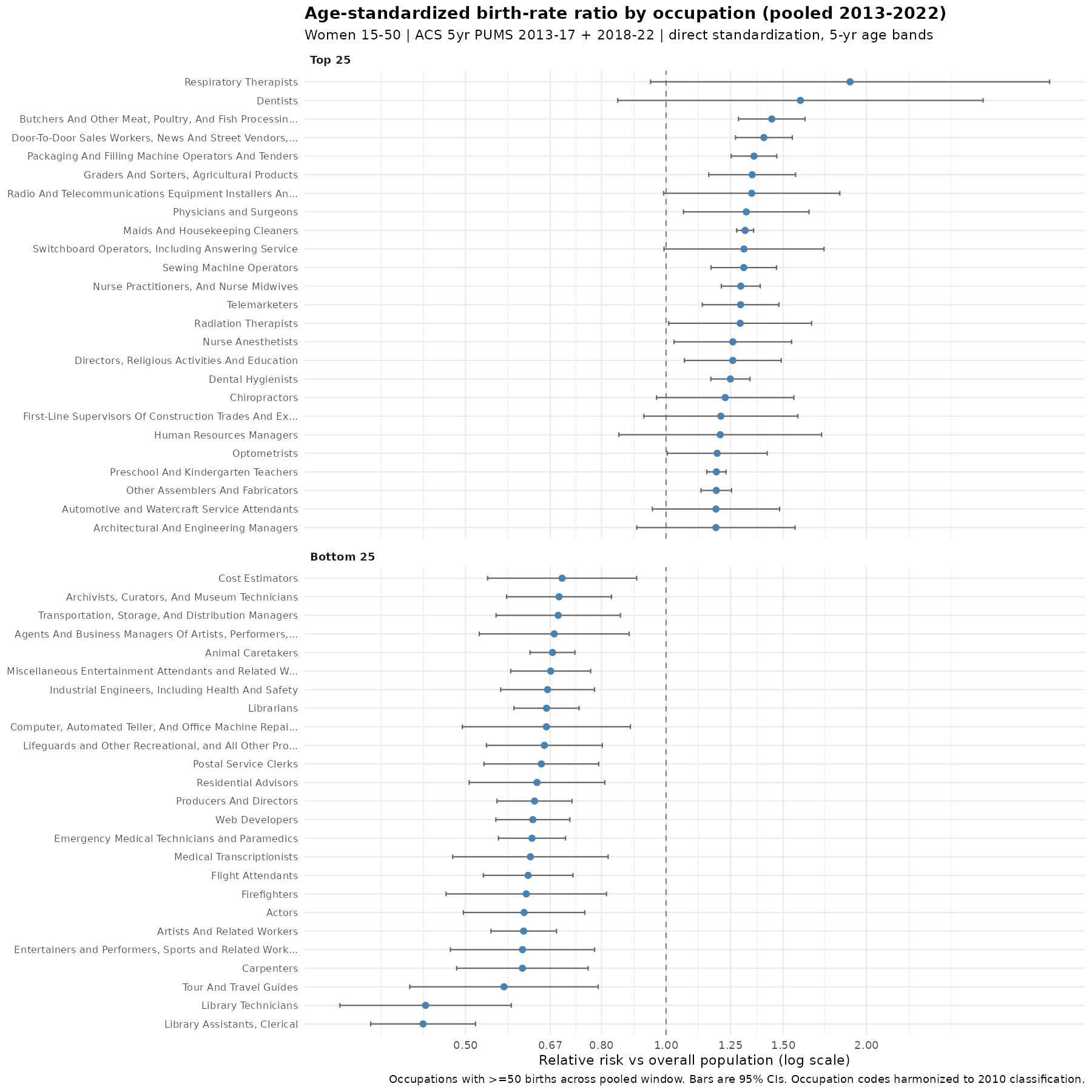
These are just the top and bottom 25 occupations. There are some questions about the causation. The most obvious interpretation is that some jobs are easier to combine with family making than others, so this would represent a causal effect from occupation to fertility. The second most obvious interpretation is that women who want to make families don’t choose their occupations at random, but choose those that are compatible with family life or otherwise preferred by (would be) mothers, and that’s why some occupations are higher in fertility. The third interpretation is that having children caused women to move into specific occupations afterwards, thus violating the stability assumption. This third option is most likely the case for telemarketer, which is presumably something women decide to do to make some money while staying at home with young children (a good working from home/remote job). However, for many other jobs, changing jobs is not so easy. Working as a nurse or physician (both in top 25) requires a long-ish degree and passing some test, so it is not so easy to just decide to change to that job tomorrow. Regarding family life compatibility, the interpretation is not so obvious for some jobs. In the low fertility group, we see flight attendants, which makes a lot of sense. They keep traveling around and pregnancy while working in mid-air sounds unwise (in fact, often prohibited). On the other hand, web development is easy to combine with family formation, but they are among the least fertile women. In the high fertility group, we see a lot of healthcare jobs, which I guess may have flexible hours, but also many are physical labor intensive (butcher, packaging, machine filling, agricultural workers) that don’t sound like they would make for good jobs compatible with motherhood. Overall, it doesn’t immediately seem that between job fertility rates are caused by the jobs themselves but rather must mainly be due to self-selection of preexisting differences among the women who choose them.