

There are hundreds of values tests on the internet. Almost all of these are theory-based also known as made-up dimensions. These are dimensions that one could think of, make some questions for (that correlate positively), but they may not exist as factor variables in real data. Real life data are usually fairly boring, since the first dimension you find is always a left-right scale using whatever features that are currently culturally relevant at that time and place. A perhaps more sophisticated idea is to look at a large international dataset of such values, perhaps they can reveal something more worthwhile. That is the point of the World Values Survey, Hofstede’s cultural dimensions and the like. They like to present their results like this:
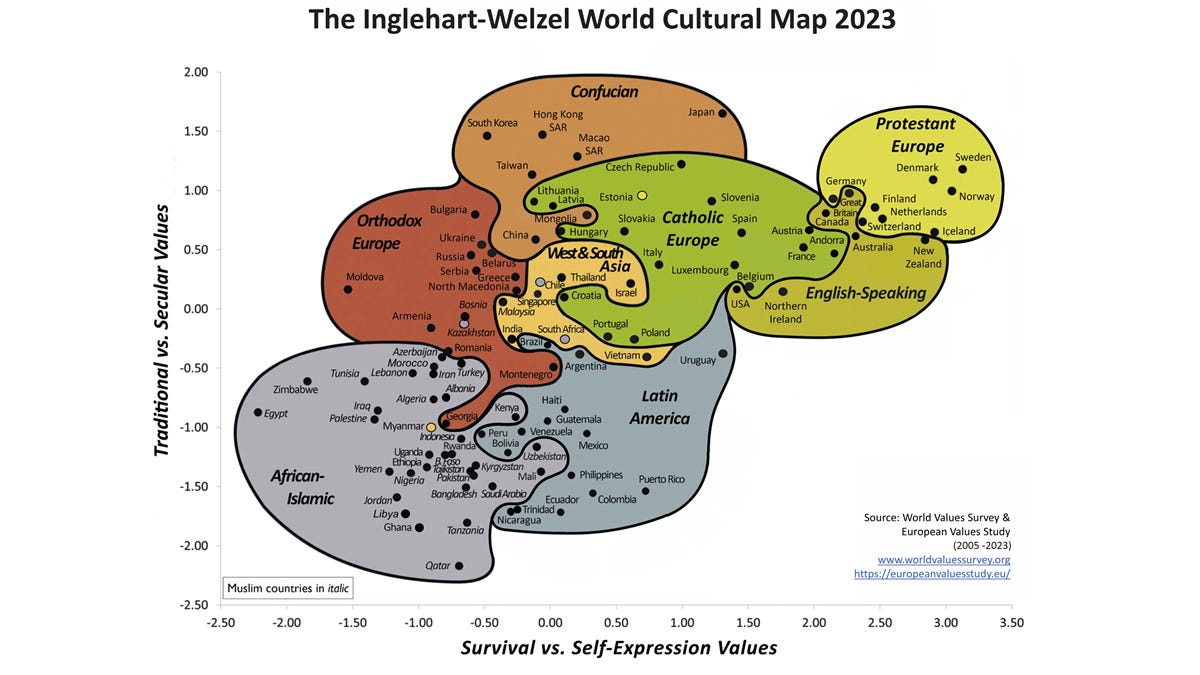
Despite being based on a large international dataset, the dimensions are in fact not ‘supported by’ the data as such (in the exploratory factor analysis sense). They are just arbitrarily defined as the 2 factors from a curated list of items. You can read about that on the website for WVS:
The two dimensions have been created by running factor analysis over a set of ten indicators. The ten indicators used (five to tap each dimension) were chosen for technical reasons: in order to be able to compare findings across time, we used indicators that had been included in all four waves of the Values Surveys. These ten indicators reflect only a handful of the many beliefs and values that these two dimensions tap, and they are not necessarily the most sensitive indicators of these dimensions. They do a good job of tapping two extremely important dimensions of cross-cultural variation, but we should bear in mind that these specific items are only indicators of much broader underlying dimensions of cross-cultural variation [Source: Chapter 2 from Inglehart, R & C. Welzel. 2005. Modernization, Cultural Change and Democracy: The Human Development Sequence. New York: Cambridge University Press].
Since these data are publicly available, I decided to download them and try again using a theory-neutral approach. The WVS data has to be merged with the European Values Sutdy (EVS) to obtain data from the list of countries above (some European countries did not participate in WVS). After filtering to the common pool of items, we are left with only 44 common value items (asked in every country). Some items of high relevance are unfortunately missing, those dealing with homosexuality, because a few Muslim countries don’t allow researchers to ask these in surveys (shame on Egypt, Tajikistan, Uzbekistan, Iran). Moving forward with the 44 items with complete coverage for 92 countries (156,658 people), we can plot our trusty parallel analysis to get an idea of how many factors we could maximally extract: