

Working with the IMDB data, we can also have another look at who makes the best movies. I previously examined this using the best foreign film category from the American Oscars. This approach precludes a comparison with USA itself, and any countries that Americas don’t include for political reasons. As we previously saw with the IMDB ratings, the distribution of scores changes over time, that is, declines. This change affects the distribution itself:
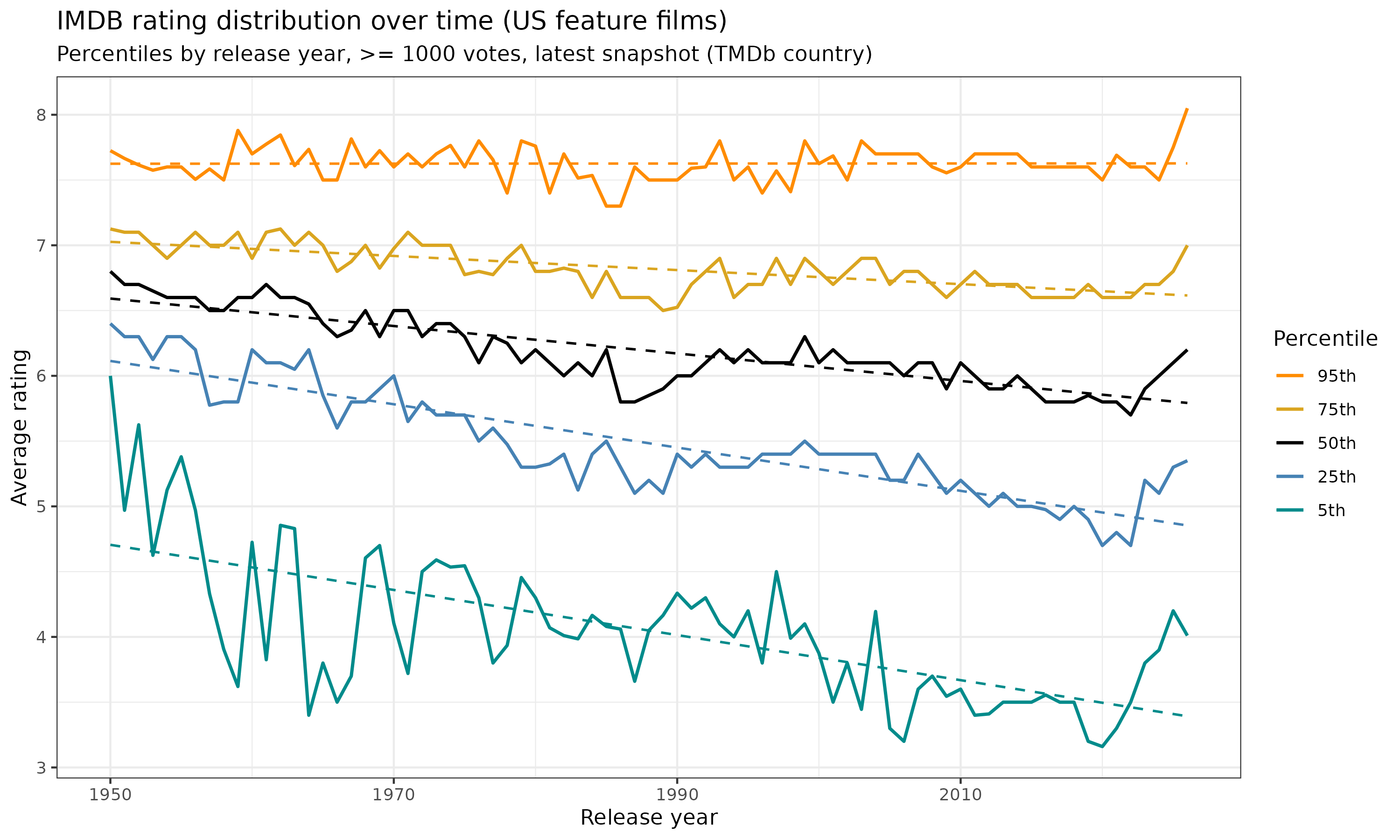
Looking at this, can see that the median (and mean) movie is declining in ratings, but the top 5% is not. The bottom 5% is declining at about twice the speed as the overall trend. This also means the variation in quality is increasing, consistent with a lowering barriers to entry model (people who had a half-baked idea for a movie in 1980 probably didn’t secure funding for this and couldn’t afford the equipment themselves, but in 2010, they could).
Anyway, if we want to know which country makes the best movies per capita, then we need a working definition of best movies. The more strict we make it, the fewer movies will be available for statistical estimation of country rates, so there is a trade-off. I went with the relatively broad definition of 7.5+ rating on IMDB with at least 1000 votes. If we plot the Oscar (best foreign) nominations per million vs. top movies per million, we get this not very nice looking plot:
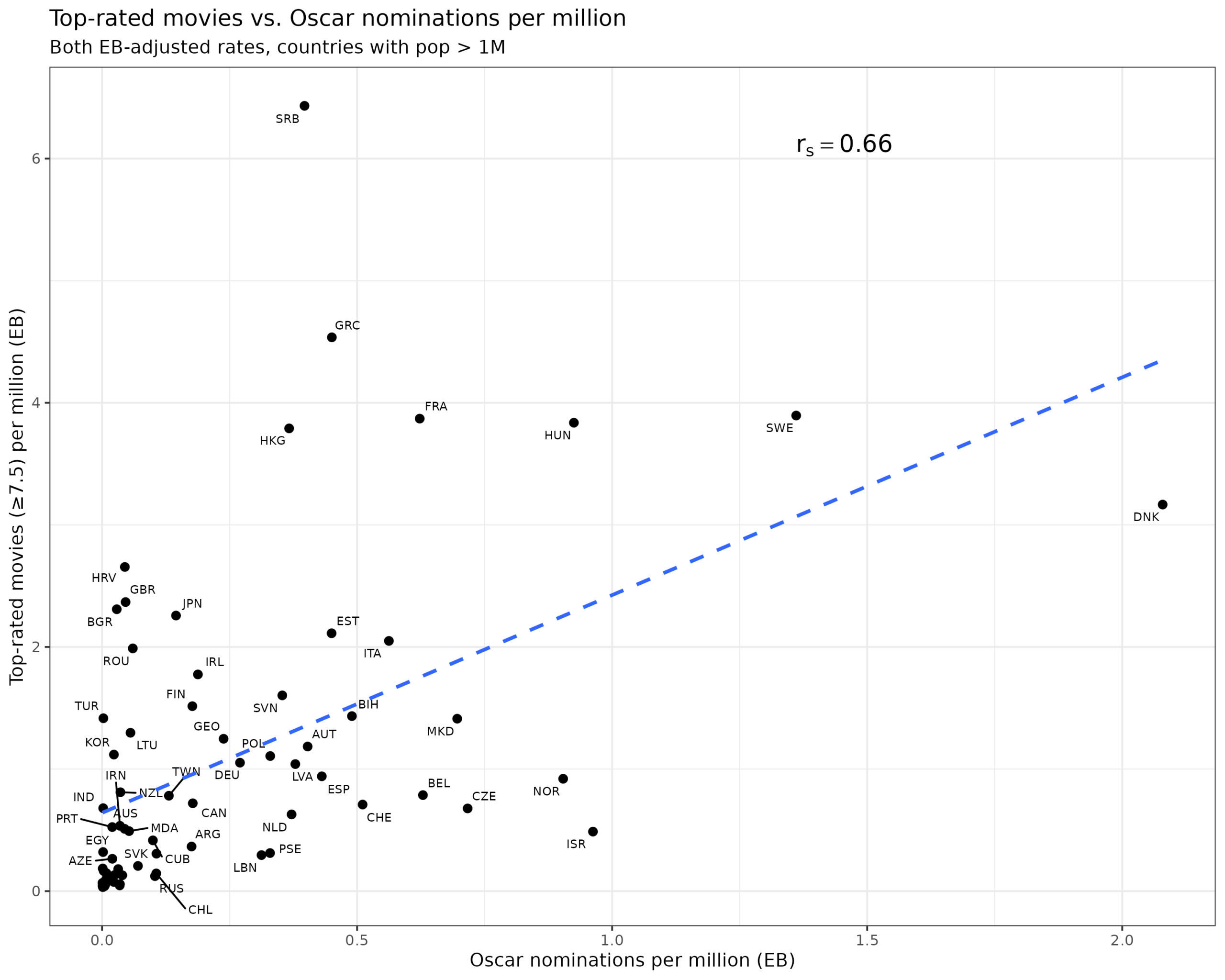
The Oscar nominations is a relatively small dataset, and we can’t be more inclusive there to improve precision. Top movies, we can change the criteria to include more or fewer as we wish. Better perhaps is to look at the total number of movies produced with at least 1000 votes. It is important to do some kind of vote count filtering because otherwise the data will be full of unknown indie movies with 9 votes (all of them friends of the makers) and mean ratings of 9.5. Top movies vs. all movies per million:
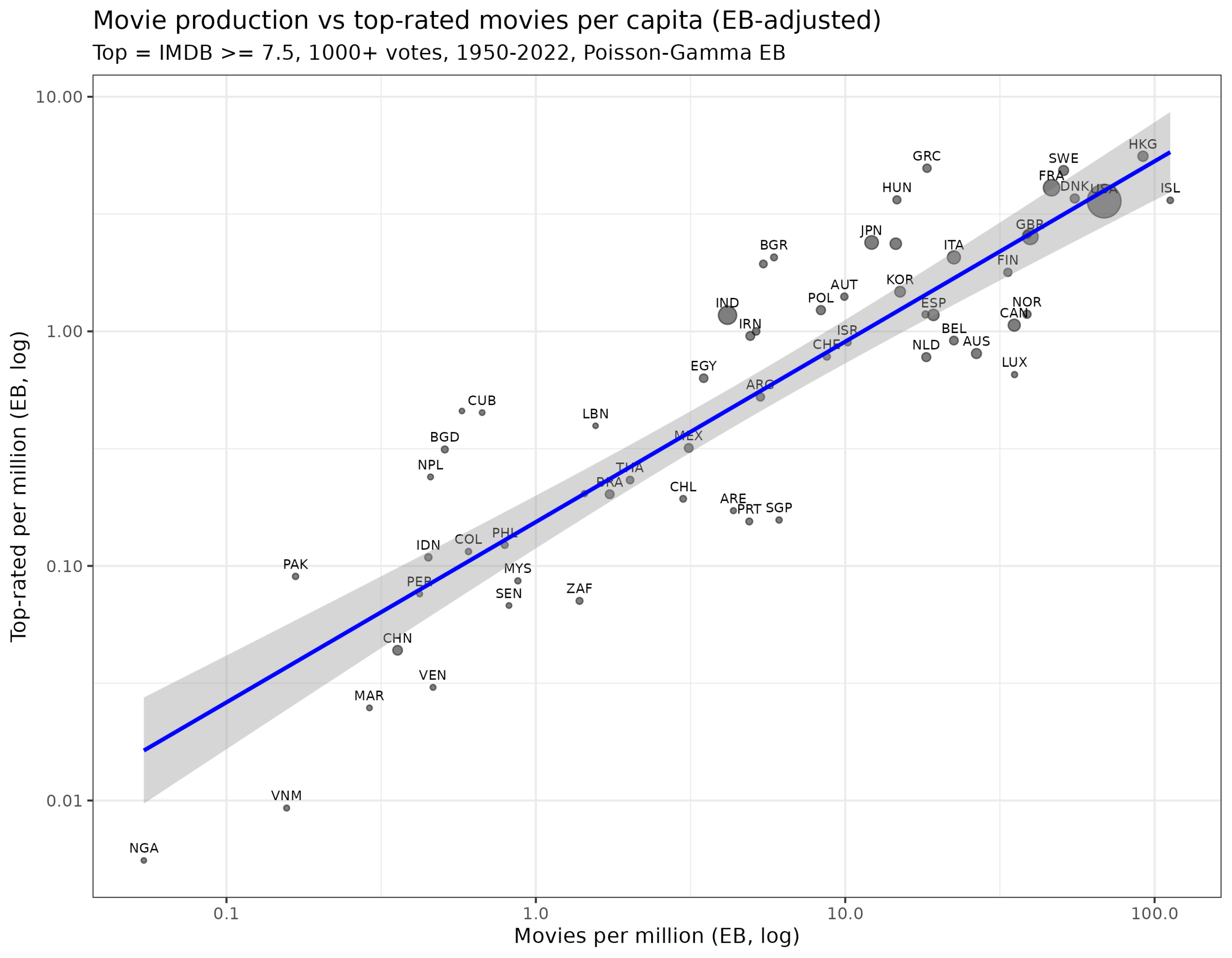
Like the other analyses, these rates are adjusted towards the mean using the empirical Bayes shrinkage method. This is because otherwise small population countries would dominate the top lists due to luck (every random semi-independent island with a population size of 50k who made one ‘top movie’ would rank in the top 10). In general, we see that there is probably little to gain from trying to subset to top movies versus just including everything produced by that country. It works the same way in science. Counting publications in top journals vs. just counting everything produces essentially the same country differences. Note also the log10 scale of the plot. Tiny Iceland (ISL) really does produce 10x the number of movies as Israel (ISR) and Austria (AUT), and over 100 times more than 3rd world countries. Granted, some of this is because no one bothers to add their movies to the Anglo-centric IMDB and vote 1000 times.
Also looking at the plot, we see that countries with more top movies than one would expect tend to have either extreme language barriers (East Asians) or ethnocentric peoples. India, for instance, produces ostensibly lots of top movies (about the same rate as Norway and Spain), to the point that using IMDB’s search engine has become unhelpful since results are full of high-rated Indian movies. Now, maybe I just don’t like Indian movies, but I figure Indians tend to just use the scale differently than other countries, that is, their ratings are inflated. Greece also shows the same pattern. The top rated Greek movie is World Gone Mad (Tis kakomoiras, 1963) with a mean rating of 8.8. This ranks it roughly the same as Pulp Fiction, Lord of the Rings, Forest Gump and so on. Perhaps this is a secret gem that only Greeks understand, but probably not. The movie doesn’t even have an English Wikipedia page and all text reviews of it on IMDB appear to be written by Greeks.
Since it is unclear exactly what metric is best, I correlated them with some other metrics of production per person:
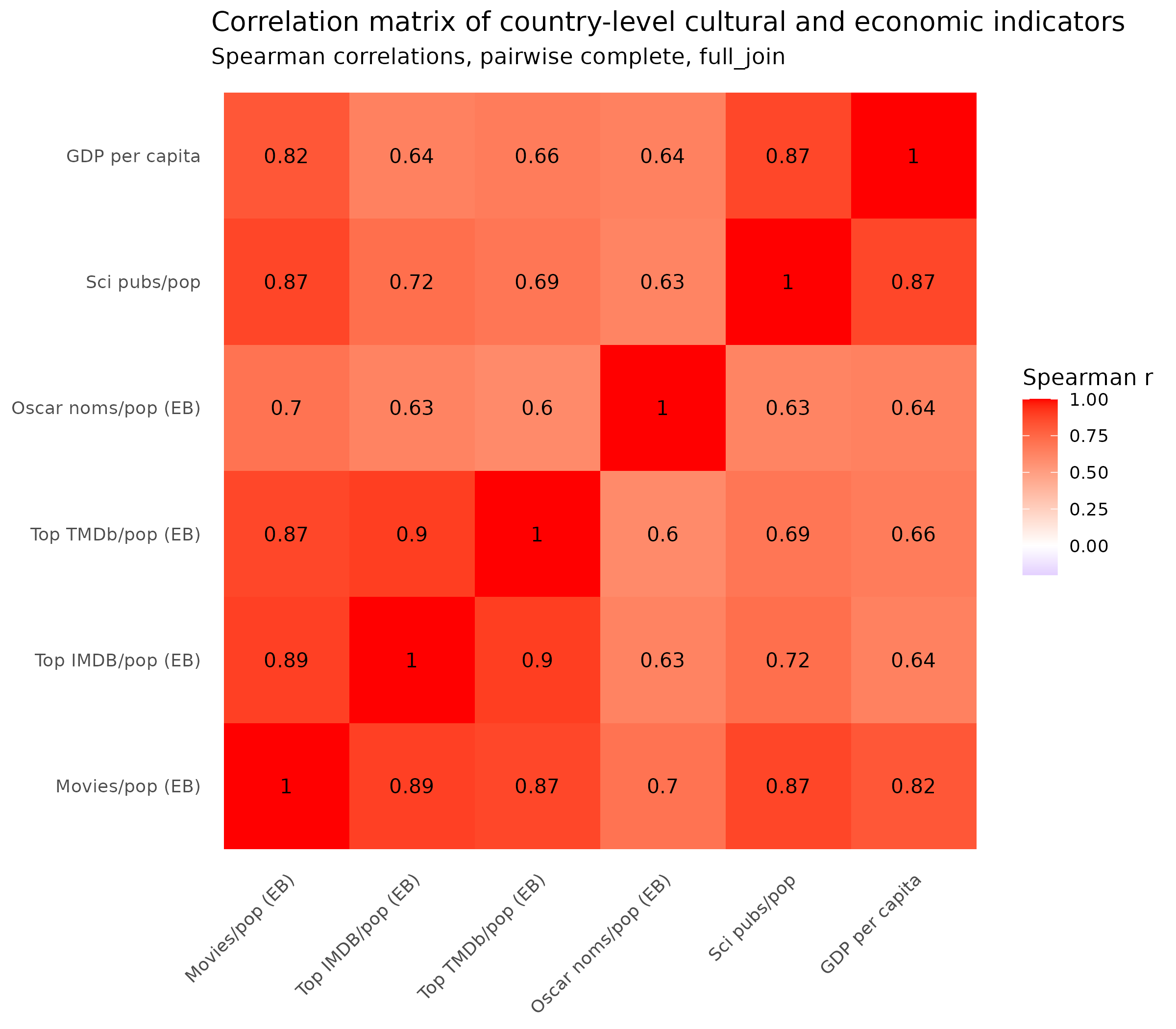
Judging from the GDP and science production metrics, the best metric is just movies/population. So who makes the most movies that people care about?: