

Some years ago we published the world’s first admixture regression studies. These were done using a series of datasets starting with the relatively small PING, then moving on to PNC/TCP, and then the ABCD. The first is about 1300 subjects, and the latter two are about 10k each. The first study was published in 2019, and the second in the same issue. The third was only published in 2023. After the initial publications, it didn’t take long for the censorship enforces to be alerted. Specifically, Kevin Bird and some of his communist/antifa friends reported Pesta to various bureaucrats at NIH and his university. They employed the shotgun argumentation approach of just making 20+ claims and hoping something would stick. This strategy was also used against Helmuth Nyborg back in 2012. In both cases it worked. The bureaucrats eventually decided that among that many and varied claims, something could be made to stick. Based on this conclusion, eventually Pesta’s tenure was revoked and he was fired. He had worked at Cleveland State University for over 20 years and was the top performer in his field. It’s the usual situation where rules concerning genuine scientific misconduct against fraud were called upon to perform their side duty, namely, to make scientists to stick to the party line on certain topics. Pesta sued the university on first amendment grounds but lost twice (original and appeal). One would think it would not be that difficult to win such a case (given the emails from the various bureaucrats revealed in discovery), but without any major monetary support for a lawsuit, I can see how the university was able to win. So now poor Bryan is out of a job, and the New York Times decided to do a hit piece on him. Their attempt at spinning the story are funny: but children’s data! And someone is Chinese! See my prior post on this.
Anyway, Bryan being now out of a job for a while has taken up writing. His latest book is a book about this affair that also doubles as a kind of updated Bell Curve. To be fair upfront, it is written with the help of AI, so the writing leaves something to be desired. If you can stomach typical LLM repetitiveness, then it is well worth your time. It is the only thing one can read to learn about this topic. It would be a nice favor to Bryan if you would buy a copy on Amazon and leave a review. At 6 USD, it’s a reasonable price for the ebook, or 13 or the paperback. It’s self-published, so Bryan gets 70% of the money.
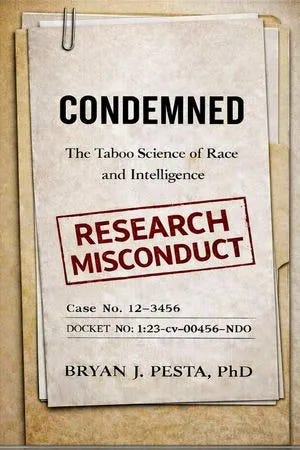
Anyway, the structure of the book consists of 54 short chapters totaling ~350 pages. Each chapter has a brief point to make. Say, current studies of intelligence’s validity to predict education, crime, health or whatever. Then scaling up gradually to population groups, mostly the typical US race groups, and finally to subnational divisions, and nations. It covers most of the recent debates about the validity of national IQs, polygenic scores for education/intelligence, as well as the perennial topics of test bias, socioeconomic status confounding, and so on. The polygenic scores comparison is a murky issue due to the lower predictive validity in non-training ancestries. To note, however, merely having lower predictive validity (smaller correlation between PGS and phenotype) is not a concern for estimating the group means correctly. I did simulations previously to prove the point. Aside from providing a review of the science on these topics, most of which is not seriously contested among experts, Pesta also provides discussion of how institutional bias and more importantly self-censorship. The chapters covering his own case are interspaced throughout the book, giving it a kind of narrative style. (Pesta also writes works of fiction, looks like erotic novels). You would be wise to censor yourself, notes Pesta:
Self-censorship is often interpreted as timidity. More often it reflects rational risk management. In practice it is usually optimization.
Early-career researchers operate under limited time, funding, and error tolerance. Their incentives reward reliability and penalize unpredictability.⁵ Pursuing controversial questions therefore resembles an investment with asymmetric downside risk.
Most respond by redirecting effort: selecting adjacent questions, adopting safer framings, or substituting less contentious variables. They rarely experience this as suppression. It feels like professionalism.⁶
Over time, prudence and conformity become difficult to distinguish.
Obviously, given the fallout of this case, others will be even more careful. If you look into the details of what procedures were used against Pesta, you will see that it is actually trivial paperwork stuff. Such as having 2 applications to use the same dataset, then submitting some formular using the wrong application. Or using a government sponsored but non-US webportal that predicts skin/hair/eye color from a few SNPs without first asking for permission. If the NIH and other bureaucrats were to look into the details of other researchers, they would surely uncover similar things, and nothing would happen. Censorship thrives under complex bureaucracies because everybody is always guilty of some error or another if you look closely enough. Since everybody is always guilty, the law can be selectively enforced against whoever doesn’t toe the party line on the controlled topics, as Pesta didn’t. Honestly, this process was eye-opening and made me even more pessimistic about the possibility of any real reform of these decadent institutions. It is probably better to literally delete the old laws and write new, simple ones that are hard to abuse. This is not likely to happen any time soon though (Trump and his boomer friends do not understand academia or research). Governments almost never simplify bureaucracy, just like they almost never lower the taxes. They are gluttonous leviathans that keep growing until they burst, with rare exceptions. (For those curious about the exceptions, we have the recent reforms by Milei targeting 300+ laws in Argentina, and Sweden’s movement away from the very high taxes of the 1980s.) Once these bureaucracies are in place, and everybody knows that it is near impossible to perfectly comply with everything, the self-interested rational actor shies away from anything that would get anyone to have a closer look at their own paperwork. And this way, without any censorship regime having to be enforced overtly, self-censorship keeps most scientists at bay. You have to admit the beauty of the system, even if it is evil.
And speaking of such things, it is also time to make another announcement. I know the media have been having a fun time referring to the Human Diversity Foundation, and its imaginary links to the Pioneer Fund and British local elections, however, the truth is that the organization is out of funds so it is going to close down soon. All the researchers have already been let go months ago. Doing this kind of research is dependent on private funding of research, but as the various media reports showed, legacy journalists are happy to spend literally years building up cover stories and send spies to various conferences, all so they can make a lame documentary and harass some nerds who look at data. If you are a wealthy person or know a wealthy person who might be interested in sponsoring more research, email me at emilowk@proton.me.
Regarding Aporia Magazine, Bo Winegard and Noah Carl will continue as usual, so don’t be worried about that. They will be extra dependent on your support now that HDF can no longer subsidize it.
HDF closure is very sad. Especially as it seems to have resulted directly from the Guardian harassment
I am afraid I am not wealthy enough to support your research but I followed your advice and ordered Pesta’s book. Have you tried with Elon Musk?